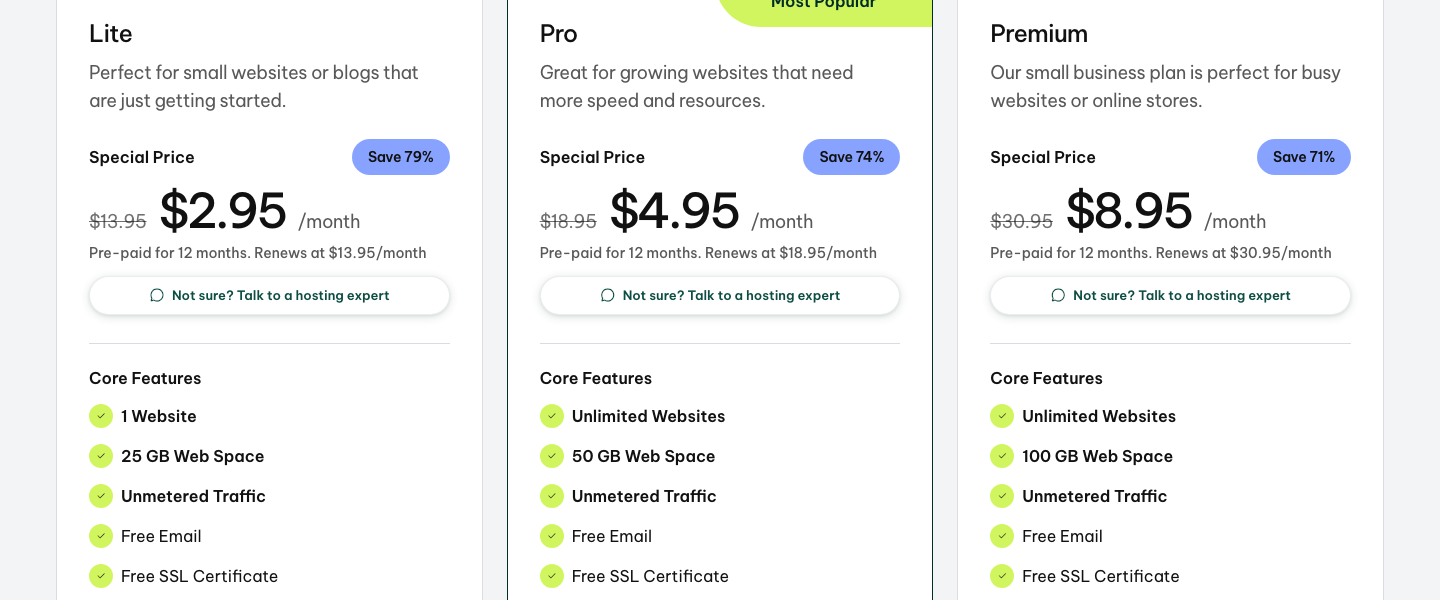
GreenGeeks Black Friday 2026 has not opened yet. What is live on 22 September 2026 is a standing sale that puts the Lite plan at $2.95/mo against a $13.95 list price. That is 79% off, not the 85% every other page is advertising, and I have a screenshot of the card.
The number that actually decides whether this is a good deal is the one underneath: Lite renews at $13.95/mo. Not a reduced renewal, not a stepped one. The full list price. Year one costs you $35.40 and year two costs you $167.40, which is a 4.7x jump and the steepest of any host I have priced this month.
The other thing worth your time here is the green claim. GreenGeeks says it matches 300% of its energy use with renewables. That is true, it is documented, and it does not mean what most people reading it assume. The certificate and the explanation are further down.
Deal status, checked 22 September 2026
- Black Friday 2026 page: not published yet
- Running now: Lite $2.95, Pro $4.95, Premium $8.95, pre-paid 12 months
- Largest real discount: 79% on Lite, not the 85% widely advertised
- Renewal: full list price on every plan, no long term rate
- Money back guarantee: 30 days
- Included on every plan: free CDN, daily backups, free domain for year one, unmetered traffic
GreenGeeks Black Friday 2026 prices and renewals
All three plans are billed as a single upfront payment covering twelve months. GreenGeeks prints the renewal rate directly on the card, which is more honest than most hosts manage, so there is no ambiguity about what year two costs.
| Plan | List price | Now | Discount | Renews at | Websites | Storage |
|---|---|---|---|---|---|---|
| Lite | $13.95/mo | $2.95/mo | 79% | $13.95/mo | 1 | 25 GB |
| Pro | $18.95/mo | $4.95/mo | 74% | $18.95/mo | Unlimited | 50 GB |
| Premium | $30.95/mo | $8.95/mo | 71% | $30.95/mo | Unlimited | 100 GB |
What three years of GreenGeeks actually costs
This is the calculation the discount percentage is designed to stop you doing. Buy the introductory year, then renew twice at the published rate.
| Plan | Year 1 | Years 2 and 3 | 3 year total | True average |
|---|---|---|---|---|
| Lite | $35.40 | $334.80 | $370.20 | $10.28/mo |
| Pro | $59.40 | $454.80 | $514.20 | $14.28/mo |
| Premium | $107.40 | $742.80 | $850.20 | $23.62/mo |
For context, DreamHost charges $95.52 for four full years on its Launch term, and Hostinger charges $136.32 for four years on Premium. GreenGeeks Lite costs $370.20 for three. That is close to four times DreamHost's price for a year less hosting, and no amount of discount framing changes it.
So is it a bad deal?
Not necessarily, but it is only a good deal if you either leave after year one or you are deliberately paying a premium for the environmental position. Those are both legitimate reasons. Believing you have locked in $2.95 hosting is not.
What the cheapest GreenGeeks plan includes
Credit where it is due. GreenGeeks does not thin out its entry plan the way most budget hosts do, and this is where its pricing starts to make more sense. Lite at $2.95 includes things that Hostinger's $2.99 plan explicitly excludes.
| Feature | GreenGeeks Lite | Hostinger Premium | DreamHost Launch |
|---|---|---|---|
| Price | $2.95/mo, 12 months | $2.99/mo, 48 months | $1.99/mo, 48 months |
| Renews at | $13.95/mo | $10.99/mo | $7.99/mo |
| Websites | 1 | 3 | 25 |
| Free CDN | Yes | No | No |
| Backups | Daily | Weekly | Daily |
| Traffic | Unmetered | Not metered by visits | 40,000 visits/mo |
| Free domain | Year one | Year one | Year one |
| Money back | 30 days | 30 days | 30 days, card and PayPal only |
Lite is a one site plan, which is its real limitation, not its feature list. If you run more than one site you are on Pro at $4.95 renewing at $18.95, and the arithmetic above gets worse rather than better.
Is GreenGeeks actually eco friendly? What the 300% claim means
This gets asked constantly and it deserves a real answer rather than either a repetition of the marketing line or a cynical dismissal. GreenGeeks documents its position properly, so the facts are checkable.
GreenGeeks works with the Bonneville Environmental Foundation, which calculates the company's annual energy consumption and then buys Renewable Energy Certificates equal to three times that figure, putting that energy into the grid. GreenGeeks explains this mechanism itself on its Going Green page, and publishes the certificate.
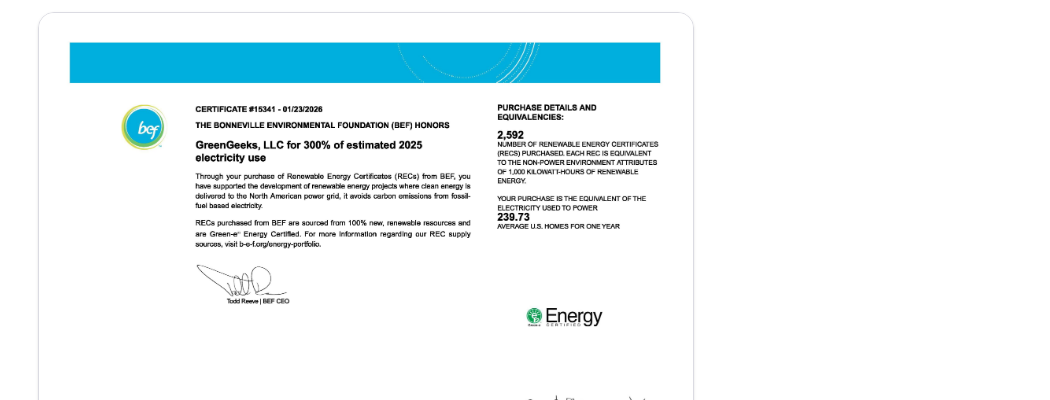
Here is what that certificate actually says, in numbers:
- Certificate #15341, dated 23 January 2026, so it is current rather than historical
- 2,592 RECs purchased, each one representing 1,000 kWh of renewable energy
- Bought against 300% of GreenGeeks' estimated 2025 electricity use, which implies actual consumption of roughly 864 MWh
- BEF equates the purchase to the electricity used by 239.73 average US homes for a year
- The RECs are sourced from new renewable resources and are Green-e Energy Certified
So the claim is accurate, independently certified and annually renewed. What it does not mean is that your website is running on wind power. The servers draw from whatever grid the data centre sits on. What GreenGeeks has bought is three times as much clean generation pushed into that grid elsewhere.
Whether that counts as green hosting is a reasonable thing to have an opinion about. My own view is that a 300% REC match with a published, dated, Green-e certified document is meaningfully better than the vast majority of the industry, which either does nothing or buys a 100% match and says nothing about where it came from. It is also not the same thing as a data centre running on renewables, and GreenGeeks, to its credit, has never said it was.

The supporting credentials check out too. GreenGeeks has been recognised by the United States Environmental Protection Agency as a Green Power Partner since 2009, plants a tree per hosting account through One Tree Planted, and holds an A+ rating with the Better Business Bureau. The company has been independent since 2008.
What is the downside of GreenGeeks?
- The renewal is the full list price. No long term rate, no stepped increase. Lite quadruples and then some.
- Twelve months is the only prepay term shown. You cannot buy four years at a lower rate the way you can at DreamHost or Hostinger, so you cannot buy your way out of the renewal.
- Lite is a single site plan. One extra project and you are on Pro, renewing at $18.95.
- Shared email deliverability. Mail from a shared hosting IP is a recurring complaint across this whole tier of the market. If email matters to your business, budget for a proper mail provider rather than relying on the included mailboxes. This applies to GreenGeeks' competitors equally.
- The advertised discount is overstated everywhere but on GreenGeeks' own site. 85% is the figure in circulation. 79% is what the card says.
- Green hosting carries a price premium. Roughly four times DreamHost over comparable periods is the size of it. Whether that is worth paying is your call, but you should make it knowingly.
What I would actually buy
If the environmental position is why you are here
Lite at $2.95, with the renewal written in your calendar. You are paying a premium for a documented 300% REC match, and that is a defensible reason to choose a host. Just do it with the $13.95 renewal in view rather than as a surprise.
If you are here because $2.95 looked cheap
Look at DreamHost instead. $1.99 on the four year term, 25 websites, daily backups, and a $7.99 renewal rather than $13.95. Four years there costs $95.52 against $370.20 for three years here.
If you are running a store
Premium, for the dedicated IP and the stronger SSL, or step outside shared hosting entirely. A dedicated IP matters for some payment gateways and for mail reputation. Measure before you commit, using the method on the How I Test page.
How these prices and claims were checked
Prices came off GreenGeeks' rendered plan cards on 22 September 2026, which is why this page says 79% where other pages say 85%. The discount badge is printed on the card next to the crossed out list price, and both are in the screenshot above.
The green claim was checked against the certificate GreenGeeks publishes rather than against its marketing copy, and the arithmetic in that section is mine: 2,592 RECs at 300% implies about 864 MWh of actual use. If GreenGeeks updates the certificate, the numbers here will move. The full method is on the How I Test page, and if a figure here disagrees with your checkout, tell me and I will correct it.
GreenGeeks Black Friday FAQ
How much does GreenGeeks cost?
On the current sale, Lite is $2.95/mo, Pro is $4.95/mo and Premium is $8.95/mo, each pre-paid for twelve months. They renew at $13.95, $18.95 and $30.95 per month respectively.
Are GreenGeeks prices only for the first year?
Yes. The discounted rate covers your first twelve months only, and the plan then renews at the full list price. There is no reduced long term renewal rate, which is different from how DreamHost and Hostinger price their longer terms.
What is the GreenGeeks renewal price?
$13.95/mo for Lite, $18.95/mo for Pro and $30.95/mo for Premium. Lite is a 4.7x increase on the introductory price, which is the steepest renewal jump among the major shared hosts.
Is the GreenGeeks Black Friday discount really 85%?
No. The largest discount printed on GreenGeeks' own plan cards on 22 September 2026 was 79%, on the Lite plan. The 85% figure circulating on deal sites does not match what the pricing page shows.
Is GreenGeeks actually eco friendly?
It matches 300% of its estimated electricity use with Renewable Energy Certificates bought through the Bonneville Environmental Foundation, documented in a Green-e certified certificate dated January 2026 covering 2,592 RECs. That is a real, audited commitment. It is a grid offset rather than direct renewable supply to the servers, and GreenGeeks describes it that way itself.
What does a 300% renewable energy match actually mean?
BEF calculates GreenGeeks' annual energy consumption, then buys certificates for three times that amount of renewable generation and feeds it into the grid. Your site still draws power from the local grid; the offset happens elsewhere at triple the volume.
Does GreenGeeks include a CDN?
Yes, on every plan including the cheapest one. That is genuinely better than Hostinger's entry plan, which excludes the CDN.
Does GreenGeeks have a money back guarantee?
Yes, 30 days.
How many websites can I host on GreenGeeks Lite?
One. Pro and Premium allow unlimited websites.
Is GreenGeeks good value?
For the first year, yes. Over three years Lite costs $370.20, where DreamHost charges $95.52 for four years, so you are paying close to a fourfold premium. That premium buys the environmental position and a better equipped entry plan.
Do I need a GreenGeeks coupon code?
No. The sale price is applied on the pricing page automatically. Pages advertising exclusive GreenGeeks promo codes are usually affiliate links with tracking attached.
Who owns GreenGeeks?
GreenGeeks was founded in 2008 by Trey Gardner and remains independent. It reports more than 55,000 customers and holds an A+ rating with the Better Business Bureau.
Related deal pages I keep updated
- Hostinger Black Friday, real prices and renewals
- DreamHost Black Friday, and the guarantee that shrank
- A2 Hosting Black Friday, and why A2 is now Hosting.com
- Cloudways Black Friday deals
- NameHero vs Hostinger, tested
- WordPress plugin deals for Black Friday
- How I test, verify and update everything on this site
Disclosure: some links on this page are affiliate links and I earn a commission if you buy through them, at no extra cost to you. Prices, discounts and the renewable energy certificate were read off GreenGeeks' own pages on 22 September 2026, from the rendered page rather than a text copy. You can read exactly how I test, verify and update everything on this site.