I wrote the first version of this WordPress tutorial in June 2020. It was five short steps, a form you could fill in for free installation help and a “secret trick” for cheap hosting. Reading it again six years later, most of it was either out of date or never quite true, and it skipped the things that actually go wrong for beginners: updates, security and backups.
So this is a full rewrite for 2027, built on WordPress 7.1.2, the current release. Every screenshot below is from a real WordPress 7.1 install I set up for this guide, a small recipe blog called Chai and Code, and every price and statistic links to where it came from. Work through it in order and you will go from never having logged in to running a secured, backed up site with your first post live.
The short answer
To learn WordPress as a beginner, try it free in WordPress Playground, then get a domain and hosting, install WordPress in one click, change six settings, pick a theme, create your core pages and menu, write your first post with blocks, add five essential plugins, and set up updates and backups. Most people can do all of it in about 7 days at an hour a day.
The PDF is this whole tutorial condensed to printable pages: the setup checklist, the day one settings, the dashboard map, the block and shortcut cheat sheet, the plugin list, the security checklist and the 7 day plan. No email required.
The whole WordPress tutorial in 12 lessons
Twelve lessons that take a complete beginner from trying WordPress for free to running a secured, backed up WordPress site with their first post published.
Try WordPress free
Open WordPress Playground in your browser and click around a disposable site with no signup.
Get a domain and hosting
Pick a domain name and entry level hosting with a one click WordPress installer. Read the renewal price.
Install WordPress
Use your host's installer, then log in at yourdomain.com/wp-admin.
Learn the dashboard
Learn the ten admin menu items and the Ctrl or Cmd plus K command palette.
Change six settings
Site title, permalinks, search engine visibility, discussion, your profile and removing sample content.
Choose a theme
Install a fast theme and set your colours, fonts and logo in the Customizer or the Site Editor.
Create pages and a menu
Publish About, Contact and Privacy pages and add them to your navigation menu.
Write your first post
Build the post from blocks, add headings, images and links, then publish.
Manage images
Upload through the Media Library and give every image descriptive alt text.
Install essential plugins
Add SEO, backups, caching, forms and security. About five plugins in total.
Set up SEO and Search Console
Configure your SEO plugin and connect Google Search Console with Site Kit.
Secure and back up the site
Turn on updates, add two factor login, schedule off site backups and check Site Health.
What is WordPress?
WordPress is free, open source software for building websites and blogs. You install it on a web server, then manage everything, writing, design, menus, users, through a dashboard in your browser without touching code. It is the most used website software in the world: according to W3Techs, WordPress runs 40.2% of all websites and holds 58.6% of the content management system market, as of 3 October 2026. The next platform, Shopify, has 5.4% of all sites.
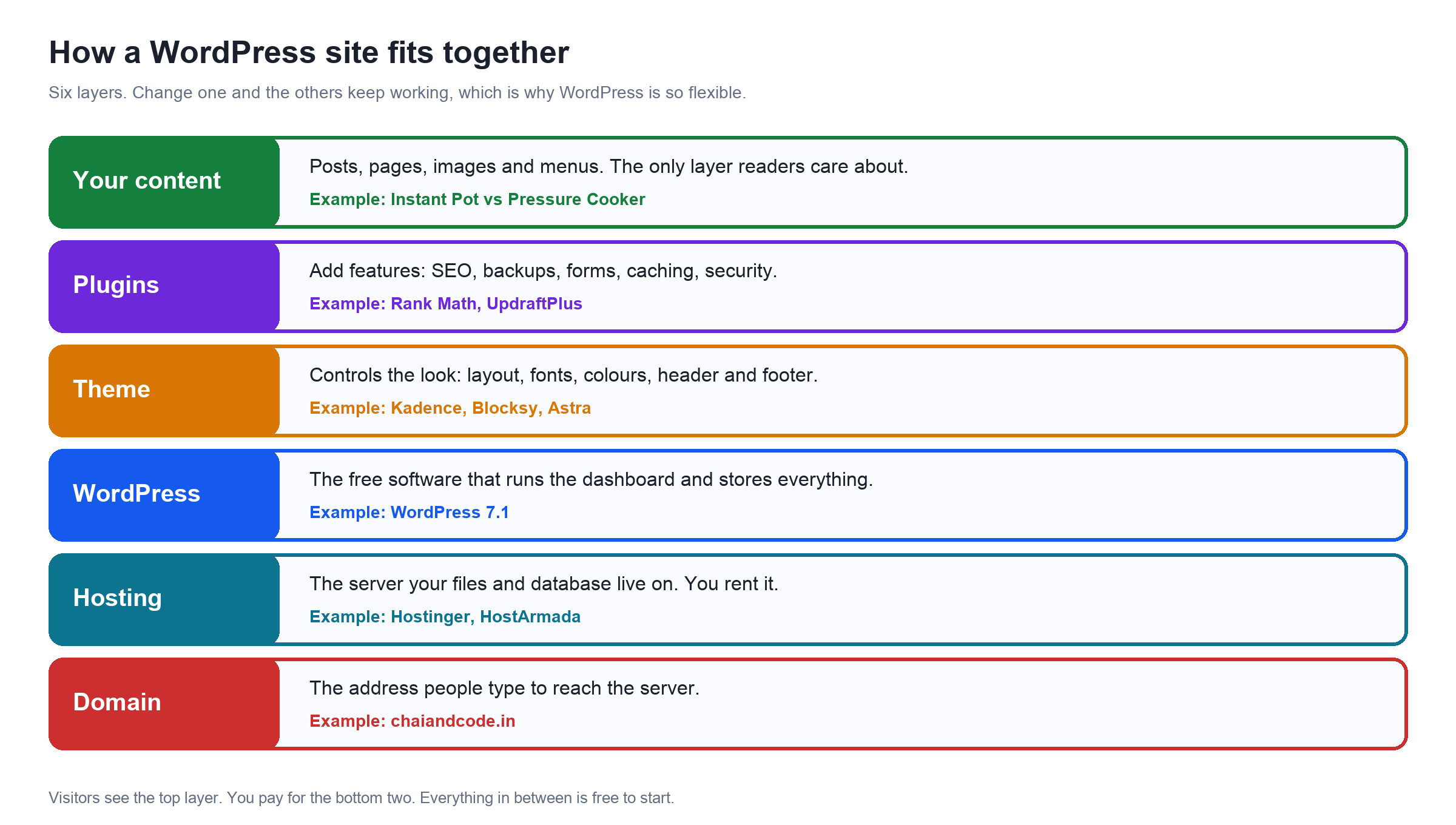
The easiest way to understand WordPress is as a stack of six layers. You rent the bottom two, WordPress itself is free, and you choose what goes on top. Change your theme and your posts stay put. Remove a plugin and your design stays put. That independence is what makes WordPress so flexible, and it is the mental model the rest of this tutorial uses.
WordPress.org or WordPress.com?
This confuses almost everyone, and the names do not help. WordPress.org is where you download the free software to run on hosting you rent; this tutorial is about that version, often called self hosted WordPress. WordPress.com is a paid hosting service run by Automattic that runs the same software for you.
| WordPress.org (self hosted) | WordPress.com | |
|---|---|---|
| Software cost | Free | Free plan, or $4 a month billed yearly for Personal |
| Hosting | You rent it from a host such as Hostinger | Included |
| Plugins | Any of the 70,000+ free plugins, plus premium ones | Every paid plan from $2.75 a month on a 3 year term; not on the Free plan |
| Themes | Any theme, free or premium | Large library, custom uploads on paid plans |
| Ads on your site | Only the ones you add | WordPress.com ads on the Free plan |
| Updates and backups | Your job (or your host's) | Handled for you |
| Best for | Blogs and sites you want to earn from and fully own | People who never want to touch hosting |
One thing older tutorials get wrong: WordPress.com's pricing page now allows plugins on every paid plan, not just Business. It is a reasonable choice if you never want to think about hosting. I still recommend self hosted WordPress for anyone who wants to earn from their site, because you own everything and nothing about your business depends on one company's plan rules.
Lesson 1: Try WordPress free before you pay for anything
The fastest way to learn WordPress is to break a WordPress site that does not matter. WordPress Playground runs a complete WordPress site inside your browser, with no hosting, no signup and no download. Open playground.wordpress.net, and within seconds you are logged in to a real dashboard.
Install themes, delete pages, change every setting you are curious about. As the Playground docs put it, changes on a temporary site disappear when you leave, which makes it a risk free place to experiment. If you want a practice site that persists on your own computer, Local is free and is what I use for every test site, including the one in this tutorial's screenshots.
Pair this tutorial with the official course
WordPress's own Beginner WordPress User course on Learn WordPress is free, takes about 4 hours over 24 lessons and was last updated in June 2026. It goes deeper on individual screens; this tutorial gives you the order to do things in and the opinions on what to pick. They work well together.
Lesson 2: Get a domain name and hosting
To put a WordPress site on the internet you need two paid things: a domain name (your address) and hosting (the server). Most beginner hosting plans include a free domain for the first year and a one click WordPress installer, so in practice this is a single purchase. If the difference between the two is still fuzzy, my explainer on what web hosting actually is covers it in five minutes.
Check two numbers on any hosting plan: the price you pay today and the renewal price after your term ends. The renewal is what you will pay for the life of the site. WordPress itself recommends PHP 8.3 or newer, MySQL 8.0 or MariaDB 10.11 or newer and HTTPS, and the WordPress Hosting Handbook now recommends PHP 8.4 for live sites. Every host below meets that.
| Plan | Price today | Renews at | Free domain | Notes |
|---|---|---|---|---|
| Hostinger Premium (India) | Rs 149 a month | Rs 449 a month | Yes, 1 year | 48 month term, rupee pricing, LiteSpeed servers |
| Hostinger Premium (US) | $2.99 a month | $10.99 a month | Yes, 1 year | 48 month term, paid up front |
| HostArmada Start Dock | $1.99 a month | $9.95 a month | Yes | 36 month term, cloud SSD |
| SiteGround StartUp | $3.99 a month | $17.99 a month | Yes, 1 year | Excellent support, highest renewal here |
Prices from each host's own pricing page, checked 26 September 2026, taxes extra. If you are in India, Hostinger Premium is where I would start: rupee pricing, a free domain and LiteSpeed servers, which means the free LiteSpeed Cache plugin works out of the box. HostArmada is the cheapest entry outside India, and I tested it properly in my HostArmada review. If you need to pay by UPI or RuPay, check which hosts accept UPI and RuPay before you pick.
If you want the blogging side of this decision, niche, domain name ideas and the cost over four years, my complete blogging guide covers it in depth, and the short guide to starting a blog is the fast version.
Lesson 3: Install WordPress
On any modern host, installing WordPress is one click. After you pay, the host's onboarding asks whether you want WordPress; say yes, choose an admin username and a long password, and the host installs it on your domain. Each host's screens look a little different, but they all ask the same three questions: which domain, which admin username and which password.
- Pick an admin username that is not “admin”. It is the first name bots try.
- Use a password manager to generate and store a long password.
- Make sure the site loads on https://. Every host here issues a free SSL certificate; turn it on if the installer did not.
- Log in at yourdomain.com/wp-admin. Bookmark it.
If your host has no one click installer, or you want to understand what the installer does behind the scenes, I recorded a full manual install in Hindi on my YouTube channel: uploading the files, creating the database and running the WordPress setup:
Lesson 4: Find your way around the WordPress dashboard
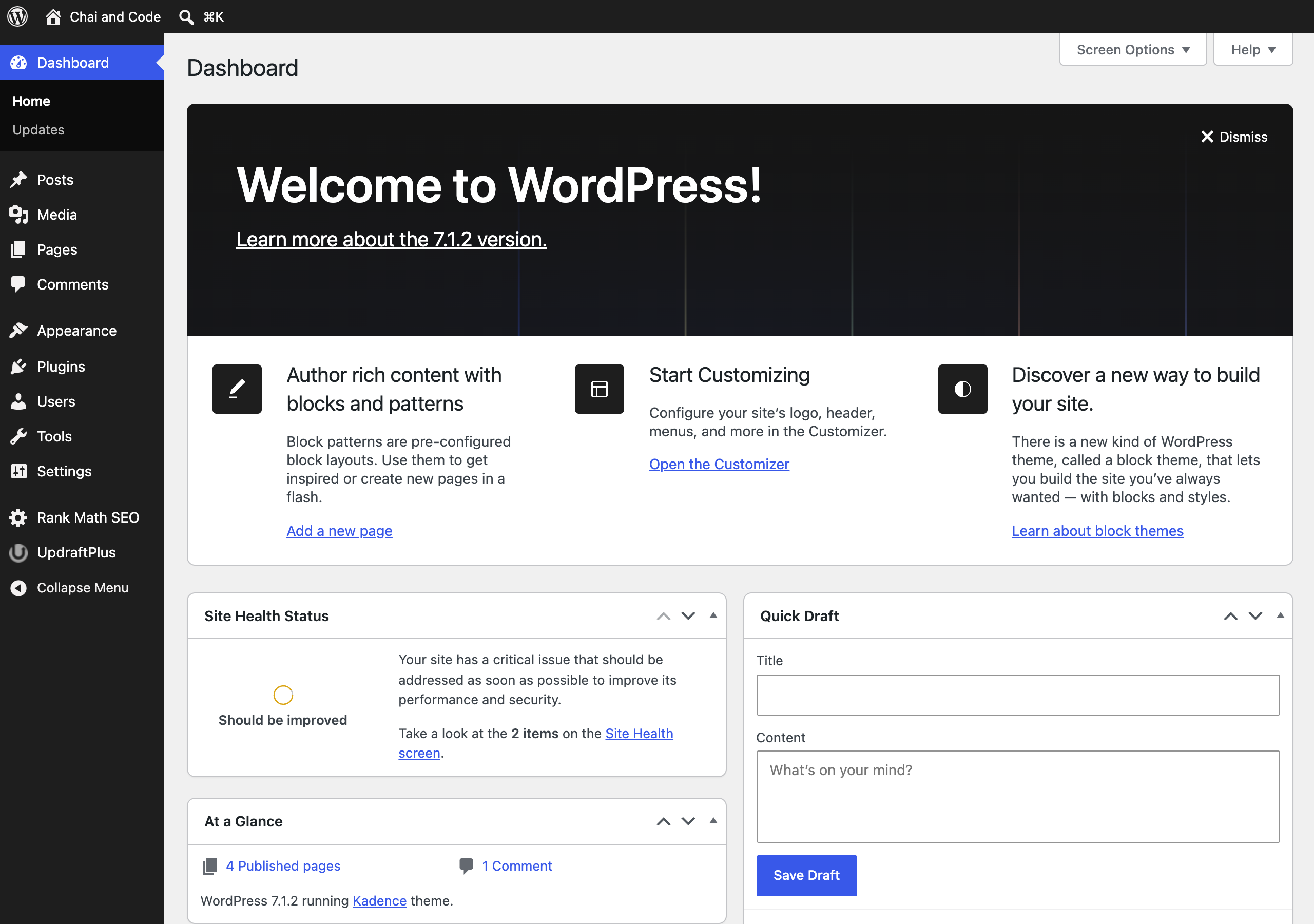
The dashboard is the admin area where you run your site, and everything lives in the menu on the left. WordPress 7.0, released in May 2026, gave it a refreshed design and a new colour scheme, so if a tutorial video shows a slightly different looking dashboard, that is why. The menu items themselves have not moved.
| Menu item | What it does | How often you will use it |
|---|---|---|
| Dashboard | Home screen with Site Health, drafts and updates | Check it once a week for update notices |
| Posts | Your dated blog articles, categories and tags | Daily, if you blog |
| Media | Every image, PDF and video you upload | Fix alt text here |
| Pages | Timeless pages such as About and Contact | Set up once, edit rarely |
| Comments | Approve, reply to or bin reader comments | Weekly |
| Appearance | Themes, the Site Editor or Customizer, menus | During setup |
| Plugins | Install, update and remove plugins | Monthly review |
| Users | Accounts and roles for everyone who logs in | When you add a writer |
| Tools | Site Health, import, export, privacy tools | Monthly Site Health check |
| Settings | Site title, URLs, reading, discussion, permalinks, Connectors | Once, on day one |
The shortcut that makes WordPress easy: the command palette
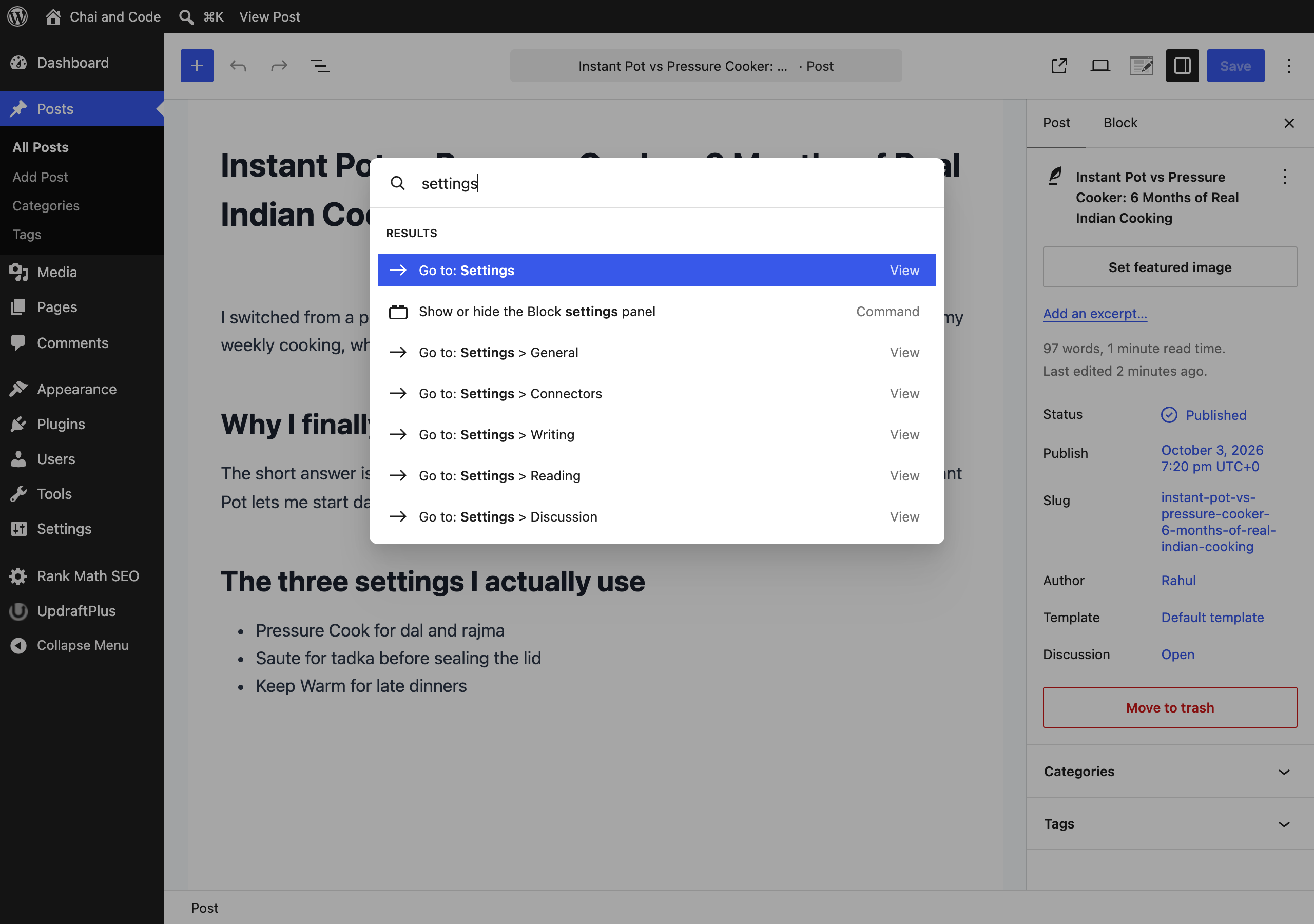
Press Ctrl + K on Windows or Cmd + K on a Mac, from anywhere in the dashboard, and a search box opens. Type what you want, “permalinks”, “new post”, “plugins”, and press Enter. Since WordPress 7.0 it works on every admin screen, not only inside the editor, and there is a search icon for it in the top admin bar. If you forget where a setting lives, this is faster than any menu.
Lesson 5: Change these six settings on day one
Six settings decide how your URLs look, whether Google can see you and whether spam goes live. Change them before you publish anything, because changing permalinks later breaks every link already shared.
| Where | What to set | Why it matters |
|---|---|---|
| Settings, General | Site title, tagline, timezone and admin email | Your title shows in Google results and browser tabs |
| Settings, Permalinks | Choose Post name | Clean URLs like /instant-pot-review/ instead of /?p=123 |
| Settings, Reading | Untick “Discourage search engines” once the site is ready | Leaving it ticked keeps you out of Google entirely |
| Settings, Discussion | Require approval for a commenter's first comment | Stops spam going live while you are away |
| Users, Profile | Set a display name and a short bio | Your name, not your username, should show on posts |
| Pages | Delete “Sample Page” and the “Hello world!” post | Default content looks abandoned to visitors and to Google |
There is also a new item under Settings that older tutorials will not mention: Connectors. It arrived in WordPress 7.0 for linking AI services, and I cover it in the AI section below. You do not need to touch it on day one.
Lesson 6: Choose and set up a WordPress theme
A theme controls how your site looks, and you can change it at any time without losing content. Go to Appearance, Themes, Add New Theme to browse the official theme directory, which lists more than 8,000 free themes. Hover over one and click Preview before you install it.
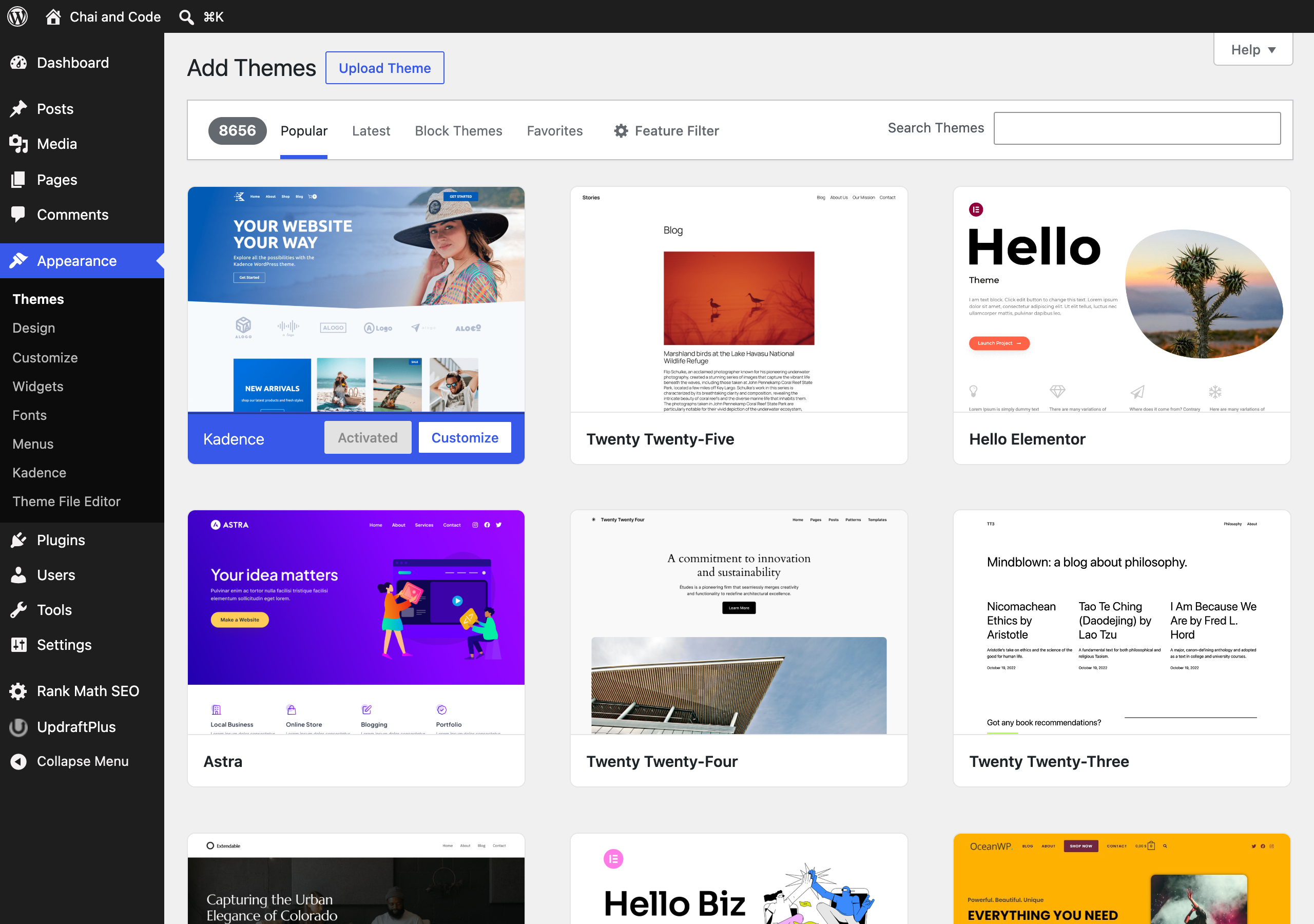
The one decision that changes how you work is the type of theme. WordPress supports two main types: classic themes, customised through the Customizer, and block themes, where you edit every part of the site, header and footer included, with blocks in the Site Editor. Both are fully supported. Here are the four I would shortlist, with figures from WordPress.org and each vendor's pricing page on 4 October 2026:
| Theme | Active installs | Rating | Type | Premium option |
|---|---|---|---|---|
| Kadence | 500,000+ | 98 out of 100 (455) | Classic, uses the Customizer | Kadence Essentials $99 a year |
| Blocksy | 300,000+ | 100 out of 100 (873) | Classic, uses the Customizer | Pro from $69 a year, $199 lifetime |
| Astra | 1,000,000+ | 98 out of 100 (6,534) | Classic, uses the Customizer | Astra Pro $69 a year |
| Twenty Twenty-Five | Bundled with WordPress | Default theme | Block theme, uses the Site Editor | Free only |
Bloggertutor itself runs on Blocksy, and I wrote about why I switched to it. Kadence is the other one I would happily build on; my Kadence vs Blocksy comparison goes through the differences in detail. Start with the free version of either. You only need Pro for things like extra header layouts, WooCommerce features or white labelling.
Customising a classic theme: the Customizer
With Kadence, Blocksy or Astra, go to Appearance, Customize. You get a live preview on the right and panels on the left for colours and fonts, header, footer, layouts and site identity, where you upload your logo and site icon. Nothing goes live until you click Publish, so experiment freely.
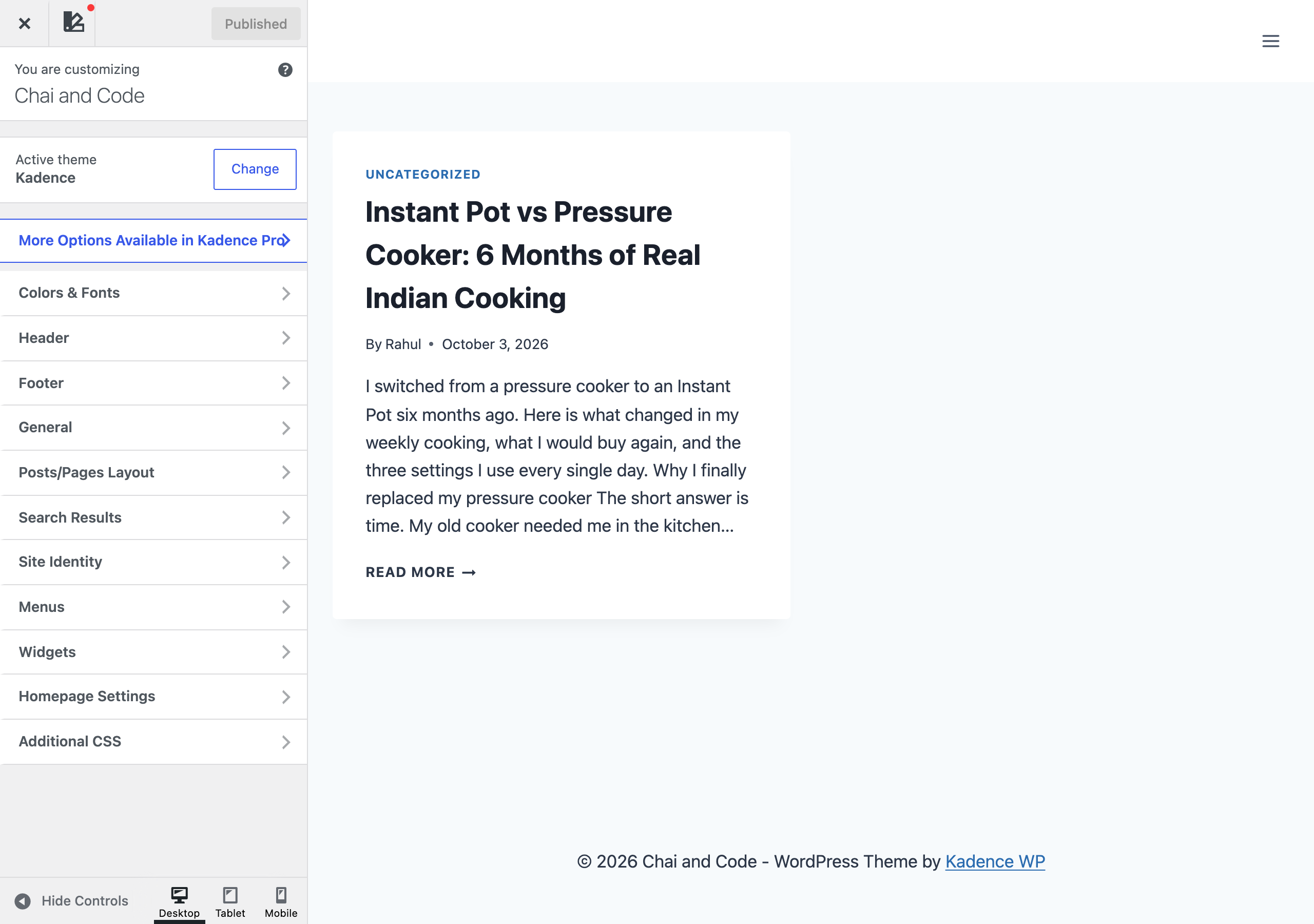
Customising a block theme: the Site Editor
With a block theme such as WordPress's default Twenty Twenty-Five, the Customizer is gone and you go to Appearance, Editor instead. The Site Editor has six sections: Identity, Styles, Pages, Navigation, Patterns and Templates. Click any part of the preview and you edit it directly with blocks, the same way you edit a post.
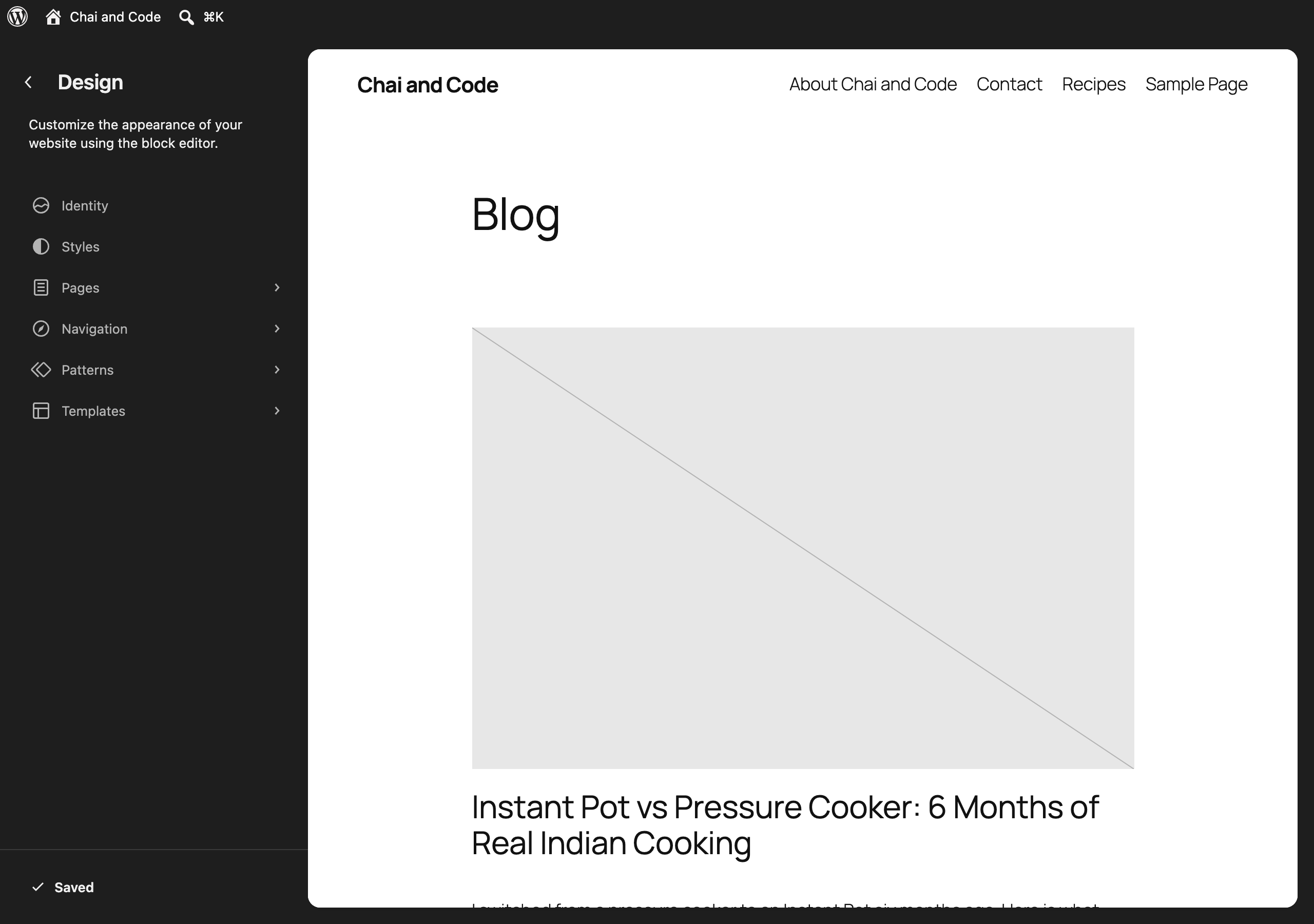
Styles is where you set colours, typography and spacing for the whole site at once. The Style Book previews every block as you change them, which saves a lot of guessing. And since WordPress 7.1 you can set responsive styles, a different size or spacing on mobile, without writing CSS.
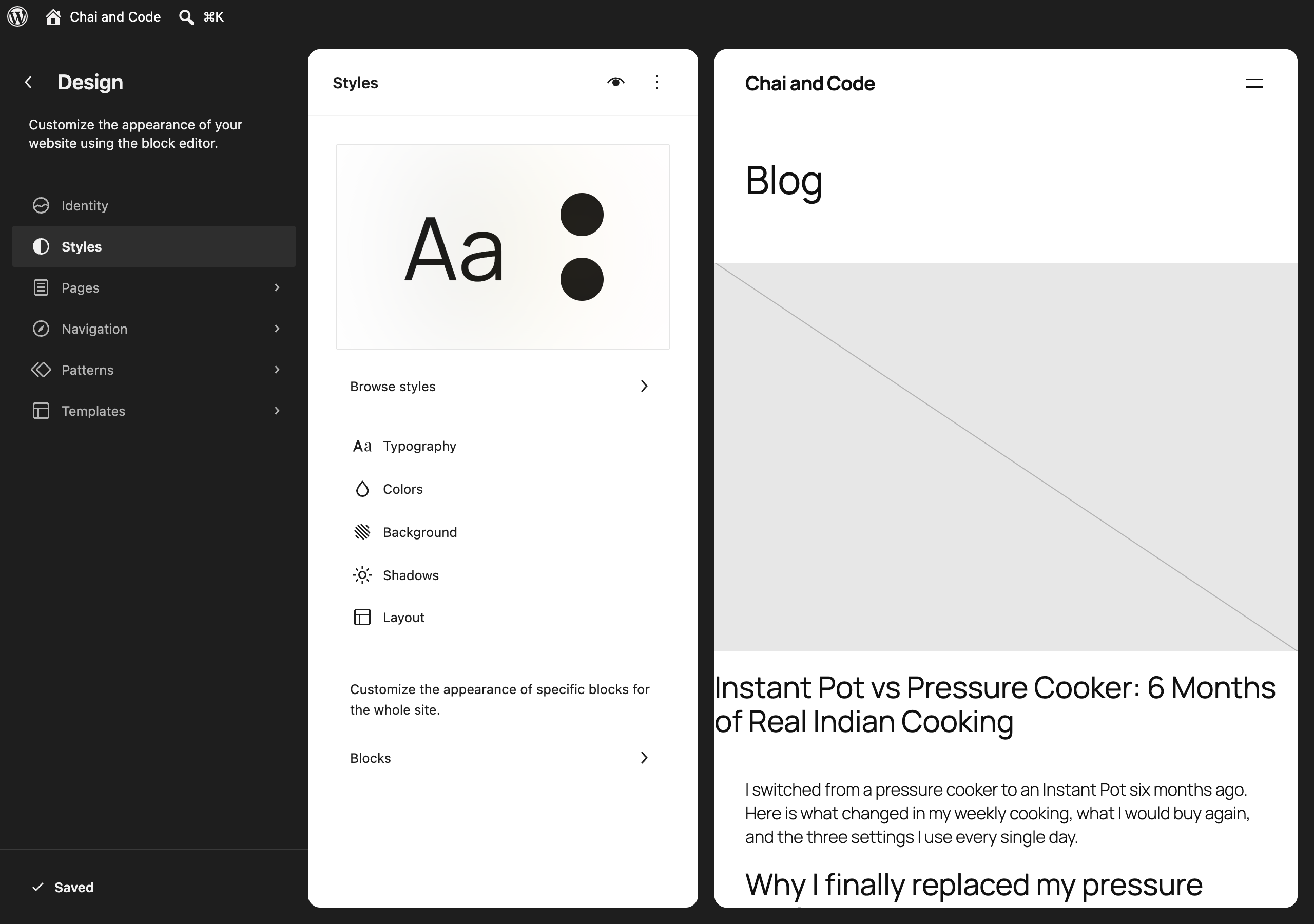
Lesson 7: Create your pages and menu
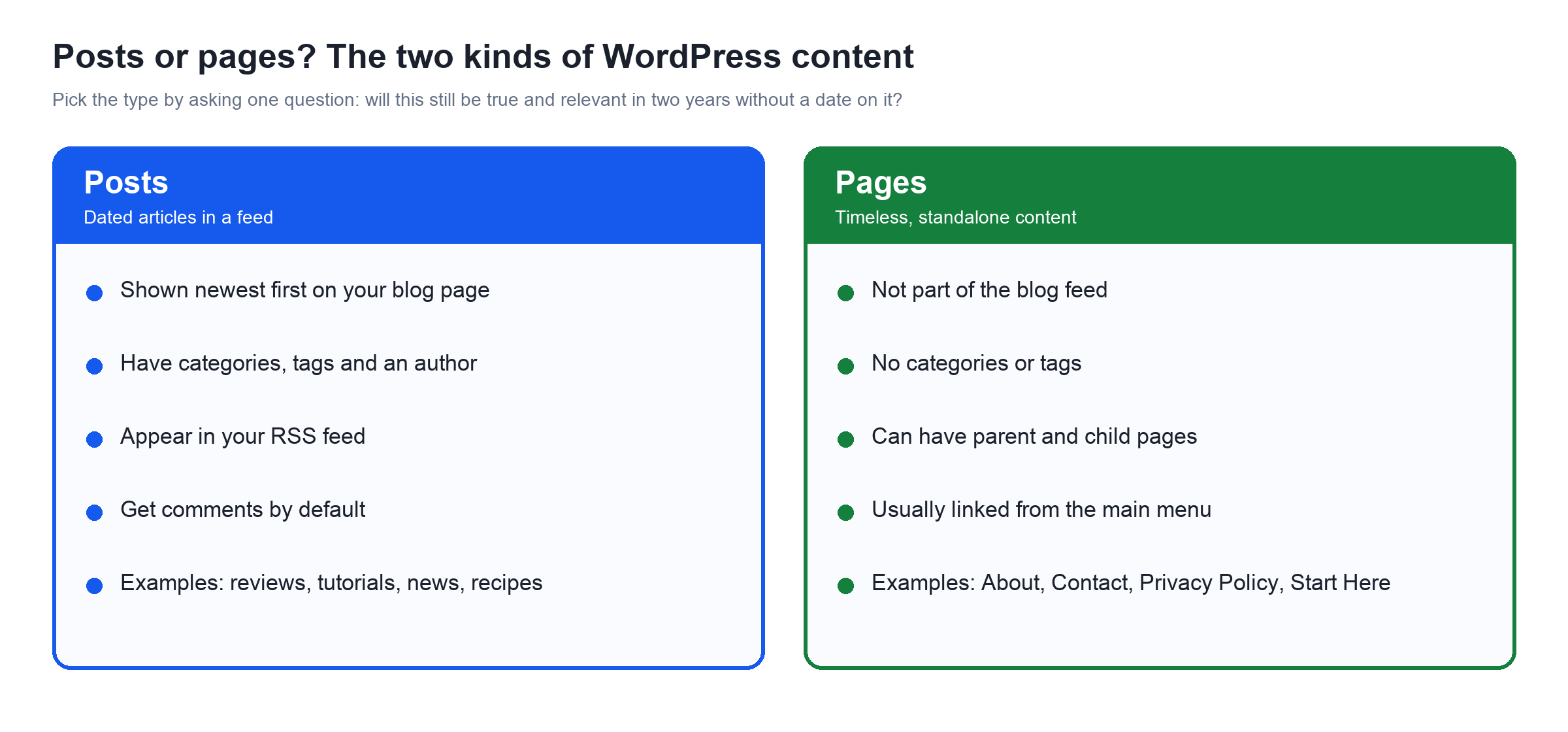
WordPress has two kinds of content: posts, which are dated articles in your blog feed, and pages, which are timeless and standalone. A review or tutorial is a post. Your About page is a page. If you are unsure, ask whether it still makes sense in two years without a date on it.
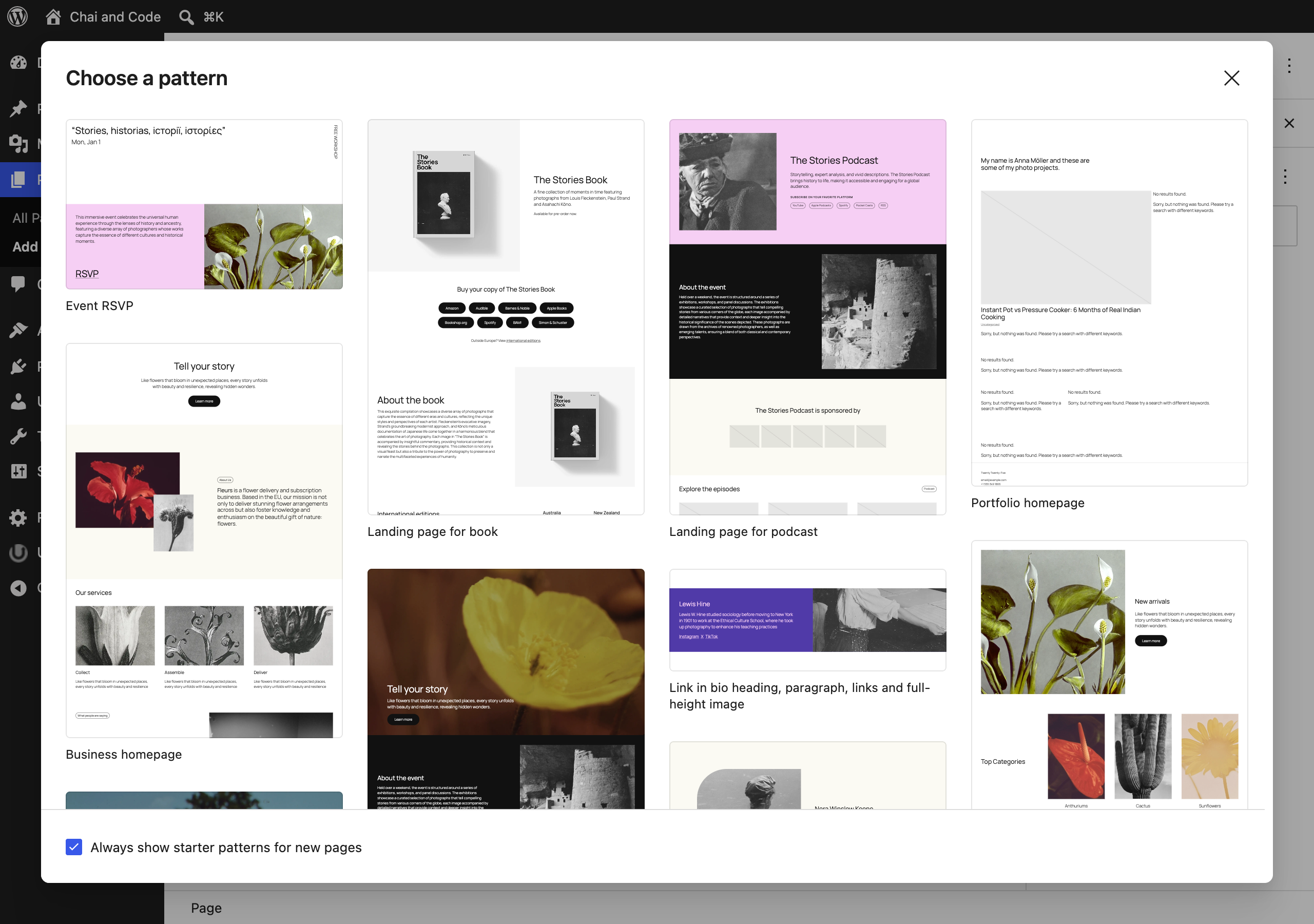
Every site needs at least three pages before it goes public: About (who you are and why anyone should trust you), Contact and a Privacy Policy, which WordPress drafts for you under Settings, Privacy. Go to Pages, Add Page. On a block theme, WordPress offers ready made layouts called patterns the moment you create a page; pick one and replace the text, or close the window to start blank.
Add the pages to your menu
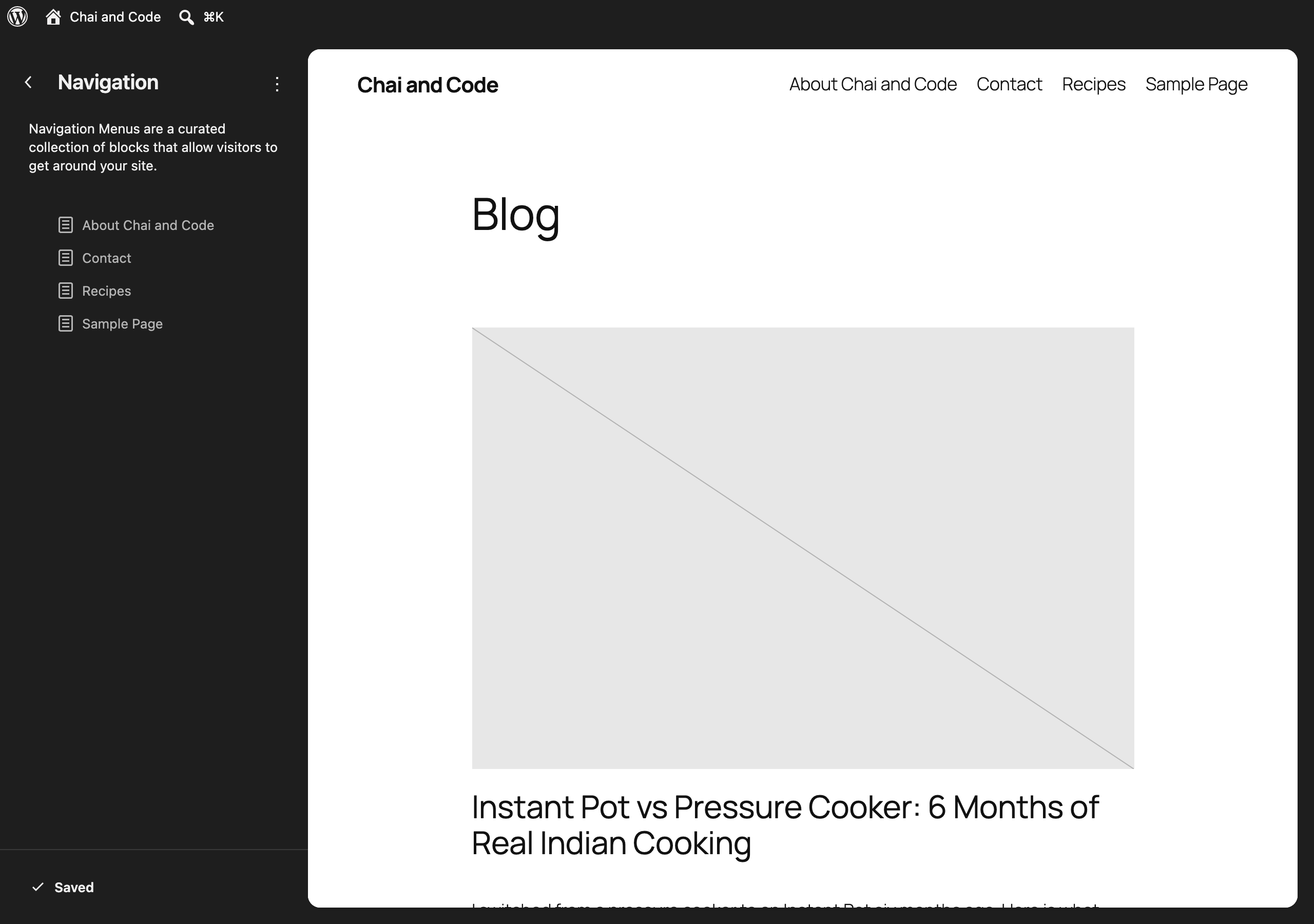
On a classic theme, go to Appearance, Menus, tick the pages and drag them into order, then assign the menu to the primary location. On a block theme the menu is a Navigation block: open Appearance, Editor, Navigation, where every menu item is itself a block you can add, drag or delete. A new block menu starts by listing all your published pages automatically, which is handy until you have more than five.
Lesson 8: Write your first post with the block editor
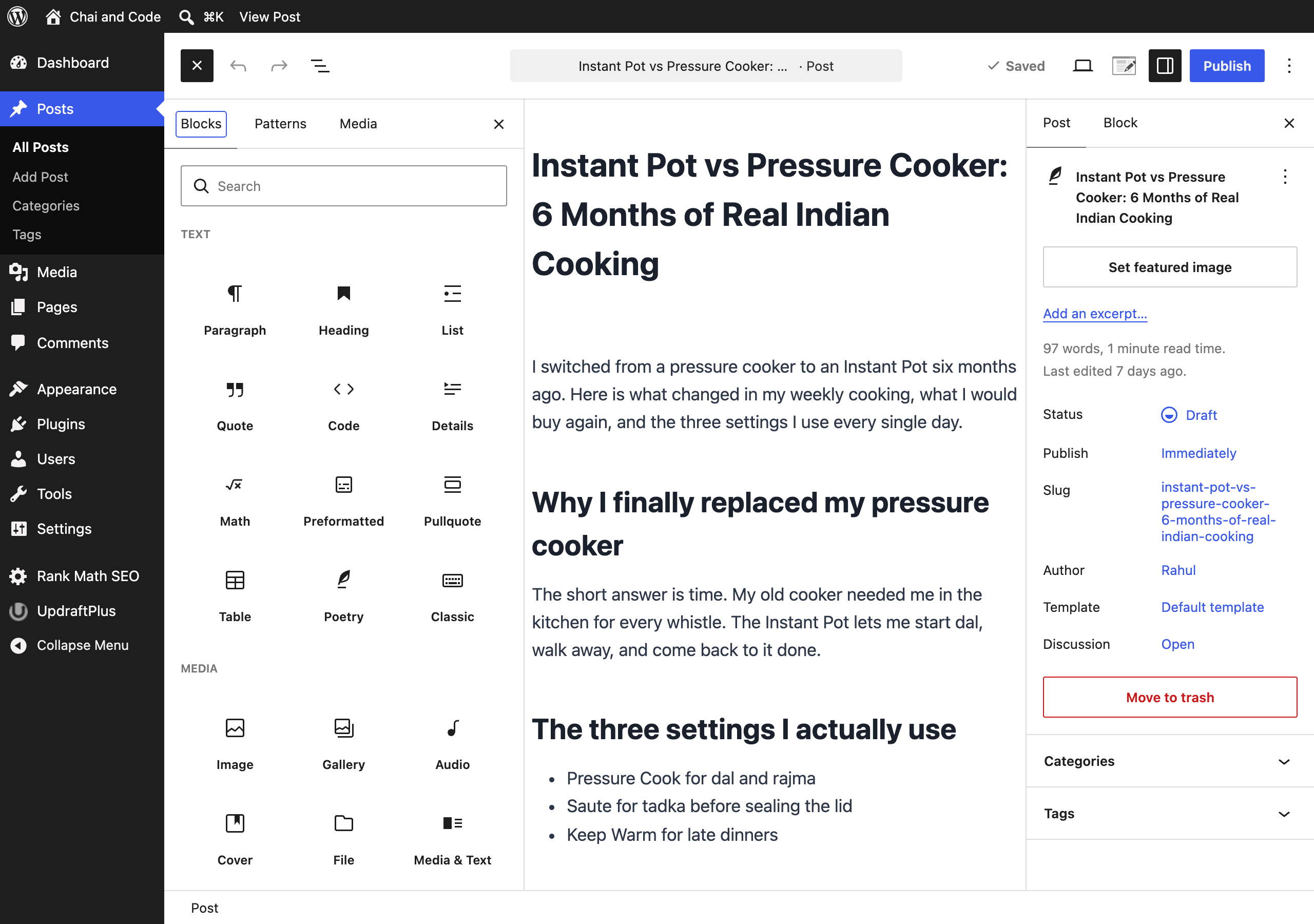
Every post in WordPress is built from blocks: a paragraph is a block, a heading is a block, an image is a block. Go to Posts, Add Post, type your title, press Enter and start writing. To add anything other than text, click the blue + in the top left to open the block inserter, or type / on an empty line followed by the block name, such as /image or /table.
There are dozens of blocks, but these ten cover almost every post you will ever write:
| Block | Use it for | Fastest way to add it |
|---|---|---|
| Paragraph | Body text. Just start typing | Enter |
| Heading | H2 and H3 section titles that build your outline | ## then space |
| List | Bulleted or numbered lists | * then space |
| Image | Upload or pick from Media, always add alt text | /image |
| Table | Comparisons, prices, specs | /table |
| Buttons | Calls to action, download links | /buttons |
| Embed | Paste a YouTube or X link on its own line | Paste the URL |
| Details | A collapsible question and answer | /details |
| Columns and Group | Layout containers for other blocks | /columns |
| Tabs (new in 7.1) | Tabbed content without a plugin | /tabs |
Keyboard shortcuts worth learning in week one
| Action | Windows | Mac |
|---|---|---|
| Open the block inserter search | Type / on an empty line | Type / on an empty line |
| Command palette | Ctrl + K | Cmd + K |
| Save draft | Ctrl + S | Cmd + S |
| Undo | Ctrl + Z | Cmd + Z |
| Add a link to selected text | Ctrl + K inside text | Cmd + K inside text |
| Duplicate the selected block | Ctrl + Shift + D | Cmd + Shift + D |
| Show all shortcuts | Shift + Alt + H | Ctrl + Option + H |
Before you press Publish
- Answer the reader's question in the first two or three sentences.
- Use H2 headings for main sections and H3 inside them, never skipping levels.
- Add at least one image or screenshot of your own, with alt text.
- Link to two or three of your other posts where they genuinely help.
- Pick one category, and set the URL slug to a short version of the topic.
- Click Preview and read it on your phone. Most of your readers will.
On the right of the editor, the Post panel holds the status, publish date, URL slug, categories, tags and featured image. Click Publish, then Publish again to confirm. If you want to go deeper on writing posts that rank, the writing and on page SEO sections of my blogging guide pick up exactly where this lesson stops.
Lesson 9: Add images the right way with the Media Library
Upload images through the block editor or Media, Add Media File, and give every image alt text that describes what it shows. Alt text is read aloud by screen readers and is how Google understands an image. “Screenshot” is useless; “WordPress Add User screen showing the role options” is right.
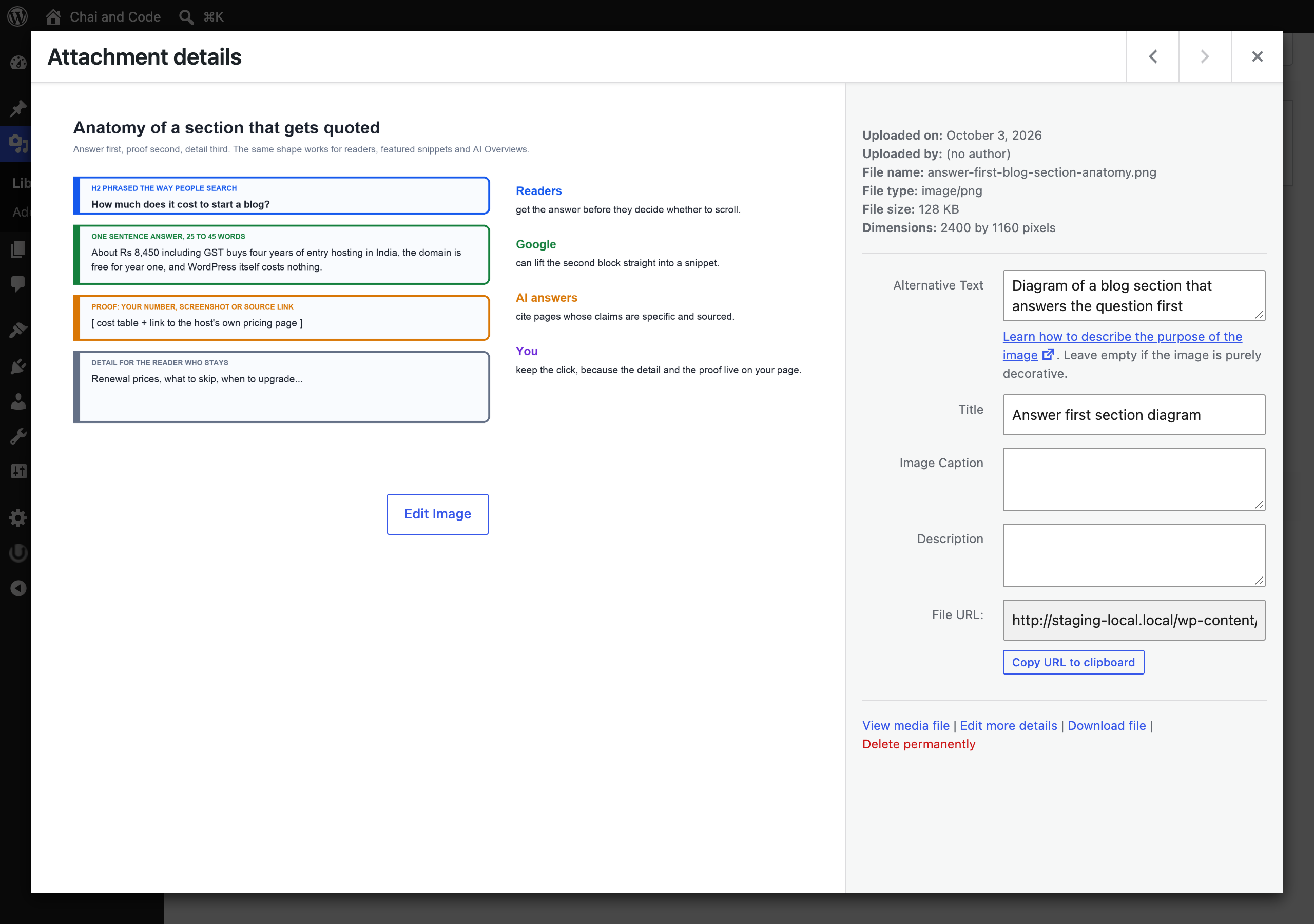
WordPress 7.1 changed what happens after you upload. According to the 7.1 release notes, compression, resizing and thumbnail generation now happen in your browser rather than on the server, AVIF and iPhone HEIC photos are supported natively, and there is a new crop and rotate editor. In practice that means fewer failed uploads on cheap hosting. Still resize photos to around 2,000 pixels wide before uploading; a 12 MB phone photo slows the page for no benefit.
Lesson 10: Install the plugins you actually need
Plugins add features to WordPress, and a new site needs about five of them. Go to Plugins, Add New Plugin, search by name, click Install Now, then Activate. The official plugin directory lists more than 70,000 free plugins, which is both WordPress's biggest strength and the most common way beginners slow down or break their sites.
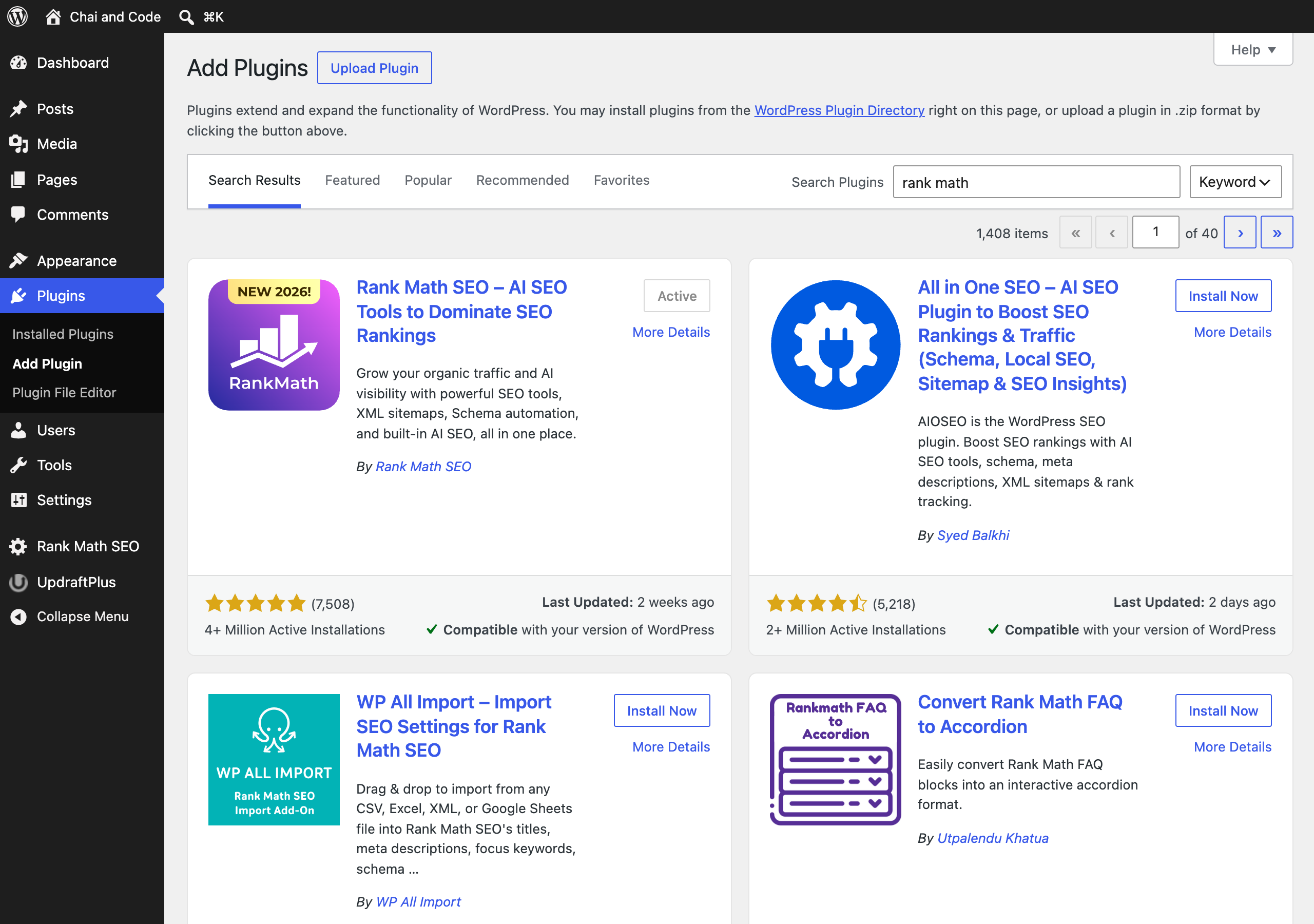
This is the starter stack I recommend. Install counts and ratings are from WordPress.org on 4 October 2026, rating out of 100 with the number of reviews in brackets:
| Job | Plugin | Active installs | Rating | Paid version | What it does |
|---|---|---|---|---|---|
| SEO | Rank Math SEO | 4,000,000+ | 96 (7,508) | PRO available | Titles, meta descriptions, sitemaps, schema |
| Backups | UpdraftPlus | 4,000,000+ | 96 (8,665) | Premium from $70 a year | Scheduled backups to Google Drive or Dropbox |
| Caching | LiteSpeed Cache | 7,000,000+ | 96 (2,774) | Free | Full page caching on LiteSpeed hosts like Hostinger |
| Search data | Site Kit by Google | 5,000,000+ | 84 (1,011) | Free | Connects Search Console and Analytics in two clicks |
| Forms | WPForms Lite | 5,000,000+ | 96 (14,381) | Pro from $49.50 first year | Contact form in minutes |
| Security | Wordfence | 5,000,000+ | 94 (5,015) | Free | Firewall, malware scan, two factor login |
If your host runs LiteSpeed, as Hostinger does, LiteSpeed Cache is all the caching you need. Do not install two caching plugins or two SEO plugins; they fight each other. Rank Math is the SEO plugin I use and have reviewed in detail, and the free version is plenty for a new site.
When it is worth paying for a plugin
None of these are needed on day one. They are the upgrades I would consider once the site has traffic, with prices from each vendor's own pricing page on 4 October 2026:
| Job | Product | Price | Refund policy | Worth it when |
|---|---|---|---|---|
| Speed | WP Rocket | $59.95 a year, 1 site | 14 days | Your host does not run LiteSpeed |
| Speed | FlyingPress | $59 a year, 1 site | No refunds, 14 day free trial | You want the fastest scores; Bloggertutor runs it |
| CDN | Bunny CDN | $0.01 per GB in Europe and North America, $1 a month minimum | 14 day trial | Readers spread across countries |
| Theme | Blocksy Pro | $69 a year or $199 lifetime, 1 site | 14 days | You want more header, layout and WooCommerce options |
| Backups | UpdraftPlus Premium | $70 a year, 2 sites | 14 days | You want incremental backups and more storage destinations |
What Bloggertutor actually runs on
WordPress 7.1.2 on PHP 8.4, the Blocksy Pro theme, Kadence Blocks Pro for layouts, Rank Math Pro, FlyingPress for caching, Site Kit by Google and Fluent Forms, hosted on Rocket.net. That is a stack I grew into over six years, not one I would hand to a beginner on day one. My Kinsta vs Rocket.net test explains why I moved hosts.
Lesson 11: Set up SEO and connect Google Search Console
Two things get a new WordPress site into Google properly: an SEO plugin to control titles, descriptions and the sitemap, and Google Search Console to see how Google sees you. Rank Math's setup wizard runs when you activate it; accept the defaults for a blog, and it creates your XML sitemap automatically.
For Search Console, install Site Kit by Google and click through its setup. Site Kit verifies your site ownership itself, by adding a verification file or meta tag, so you do not have to copy codes around. If you prefer to do it by hand, my Search Console verification guide shows every method, and Rank Math's Instant Indexing gets new posts discovered faster.
Speed is part of SEO too. Google's Core Web Vitals measure three things, at the 75th percentile of real visits:
| Metric | Good score | What it measures |
|---|---|---|
| Largest Contentful Paint (LCP) | 2.5 seconds or less | How fast the main content appears |
| Interaction to Next Paint (INP) | 200 milliseconds or less | How quickly the page reacts to a tap or click |
| Cumulative Layout Shift (CLS) | 0.1 or less | How much the layout jumps while loading |
A lightweight theme, a caching plugin and compressed images get most new WordPress sites into the good range without any further work. If yours is not, my WordPress speed guide and the post on free Cloudflare CDN setup are the next steps.
Lesson 12: Keep WordPress secure, updated and backed up
Most WordPress security problems come from plugins, so keeping them updated is the single most important security habit. Patchstack's State of WordPress Security in 2026 report counted 11,334 new vulnerabilities in the WordPress ecosystem in 2025, up 42% on the year before. 91% were in plugins, 9% in themes, and only 6 in WordPress core itself.
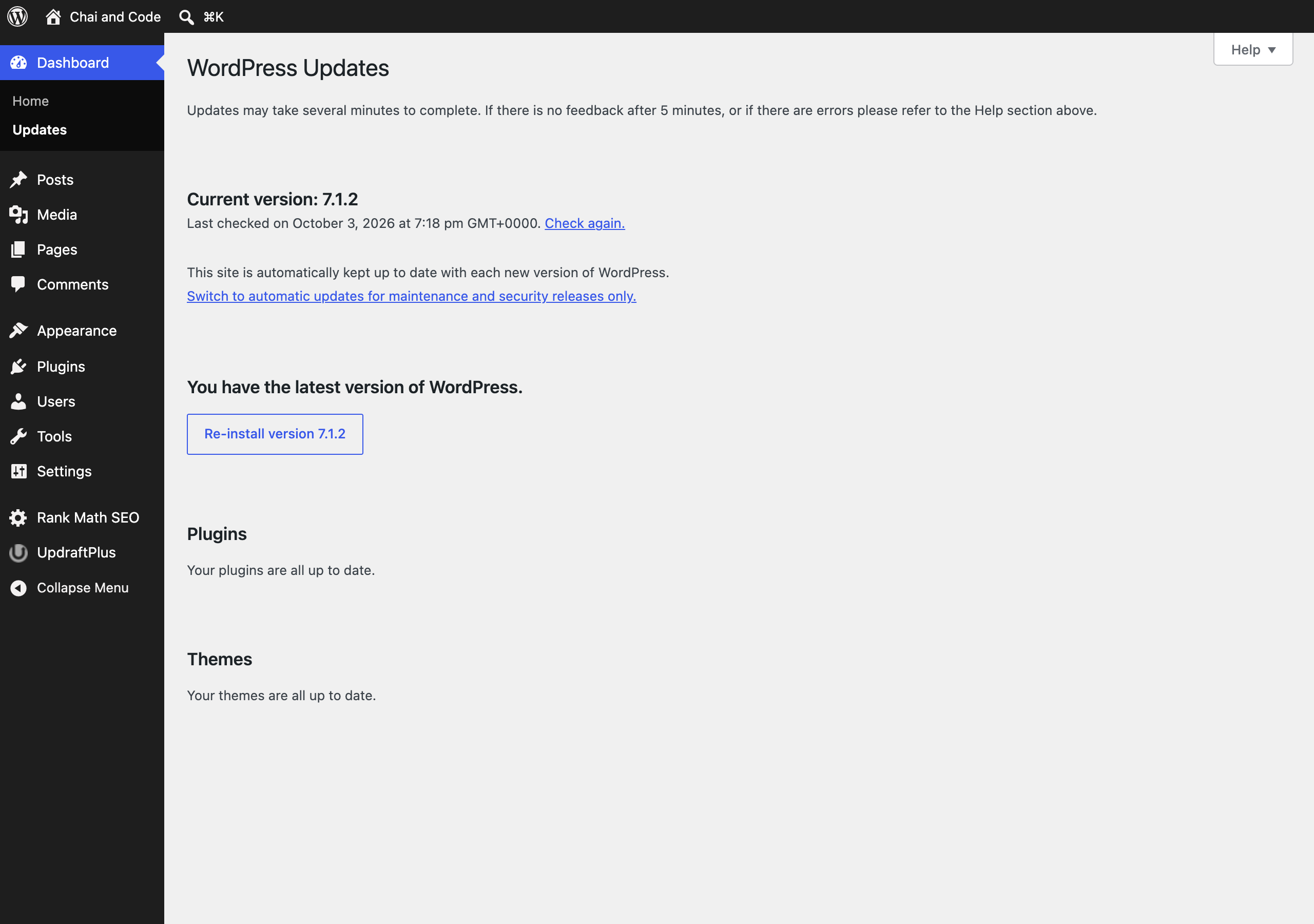
Core is not immune, which is why automatic updates matter. On 22 September 2026, WordPress 7.1.2 fixed a critical flaw that Wordfence rated 9.2 out of 10, with fixes pushed to every version back to 4.7. Sites with automatic background updates got it without anyone lifting a finger. Check Dashboard, Updates to confirm yours are on.
The security checklist I use on every new site
- Turn on automatic updates for plugins you trust, from the Plugins screen.
- Use a long, unique password and add two factor login (Wordfence includes it free).
- Never use “admin” as a username, and give writers the lowest role that works.
- Delete themes and plugins you are not using. Inactive code can still be attacked.
- Keep one backup off the server, in Google Drive or Dropbox, and test a restore.
- Only install plugins from WordPress.org or the developer's own site, never “nulled” copies of premium plugins.
Give every user the lowest role that works
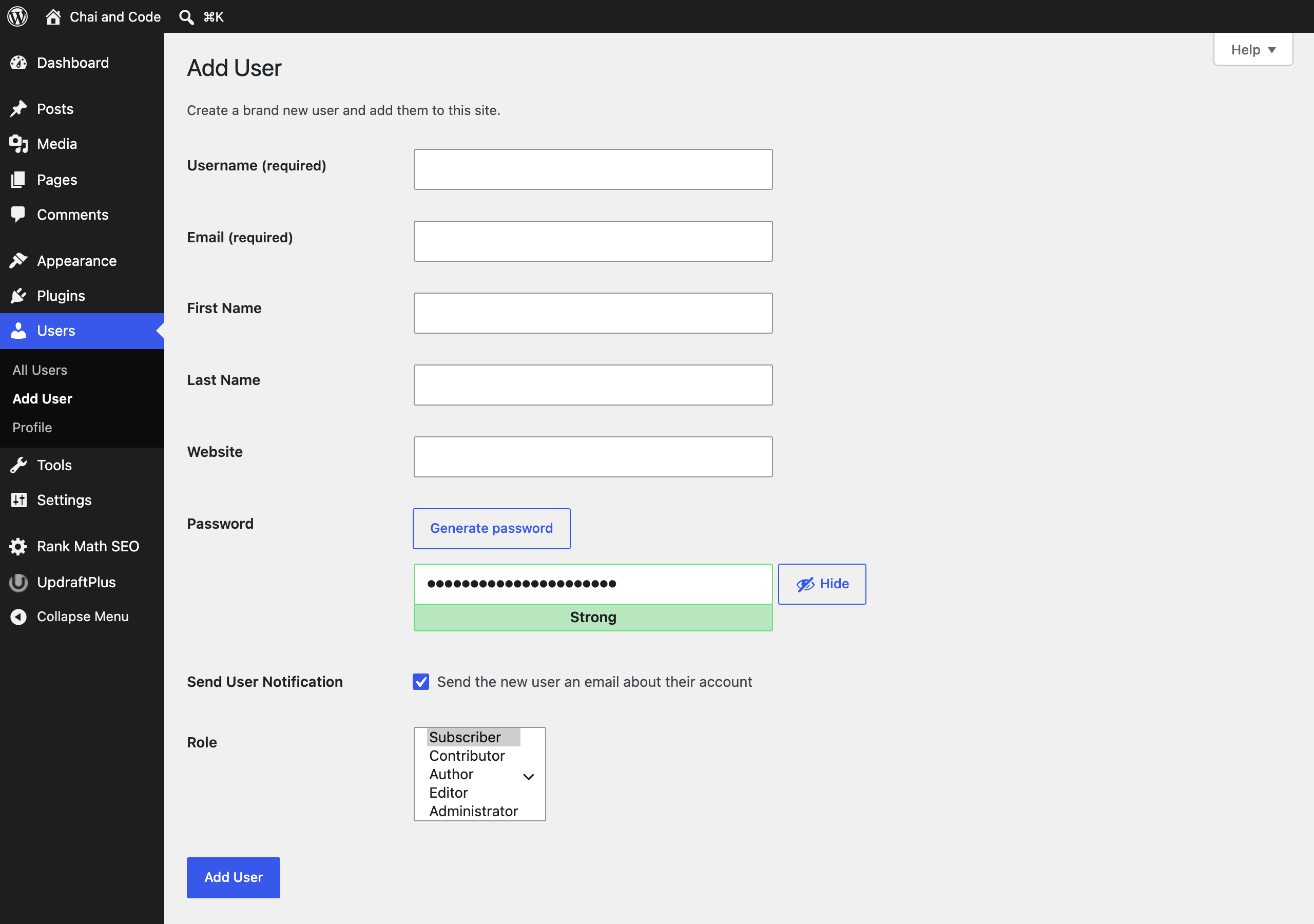
When someone else writes for you, add them under Users, Add User and choose a role. Each role can do less than the one above it:
| Role | Can do | Give it to |
|---|---|---|
| Administrator | Everything, including plugins, themes and users | Only you |
| Editor | Publish and edit anyone's posts and pages | A trusted co-editor |
| Author | Publish and edit their own posts | A regular writer |
| Contributor | Write drafts, cannot publish or upload | A guest writer |
| Subscriber | Manage their own profile only | Readers on a membership site |
Check Site Health once a month
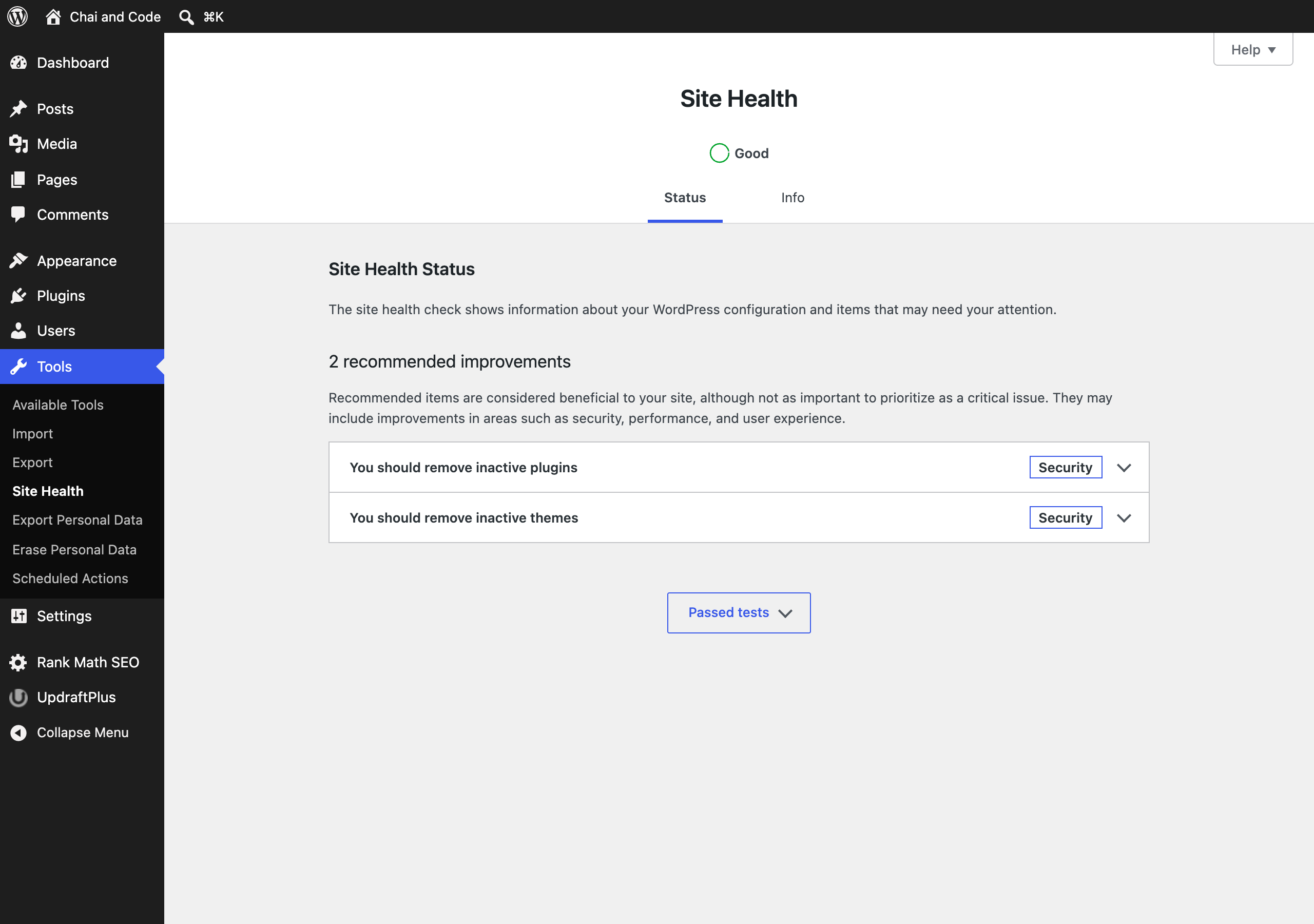
Tools, Site Health runs WordPress's own checks: outdated PHP, inactive plugins and themes that should be removed, missing HTTPS, failing scheduled tasks. Aim for a Good status and work through anything marked critical. It takes five minutes and catches most problems before they become outages.
Back up to somewhere other than your server
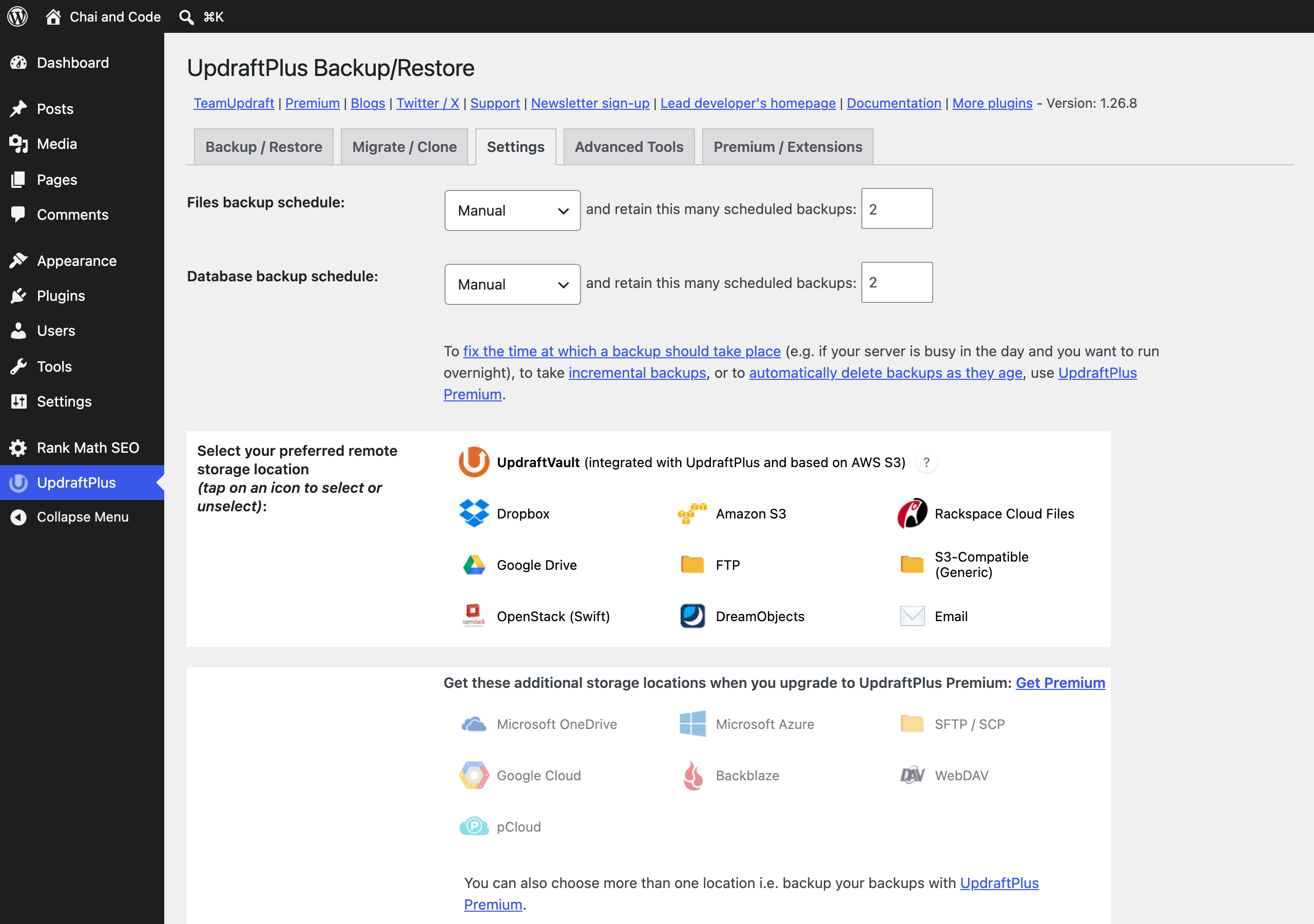
Most hosts keep backups, but a backup on the same server as your site is not much use if the account is compromised or suspended. UpdraftPlus's free version schedules backups to Google Drive, Dropbox and other remote storage. In Settings, UpdraftPlus Backups, set files to weekly, the database to daily, pick a remote destination and save. Then do one test restore so you know it works before you need it.
Keep the backup plugin itself updated too. In June 2026 Search Engine Journal reported an authentication bypass in UpdraftPlus affecting around 3 million sites, fixed in version 1.26.5. That is the point of this whole lesson: popular, well maintained plugins get patched quickly, and the sites that get hurt are the ones nobody updates. I compared the two backup plugins I trust in WPvivid vs UpdraftPlus, and if you ever change hosts, my migration guide uses the same backups to move the site.
WordPress and AI in 2027: what changed
WordPress 7.0 built AI into the core software for the first time. Search Engine Journal called native AI the defining feature of the 7.0 release. In practice, WordPress now has a central Connectors screen under Settings where you connect an AI provider once, Anthropic, Google or OpenAI out of the box, and any plugin can then use it. Back in March, WordPress had already released official AI provider plugins for all three.
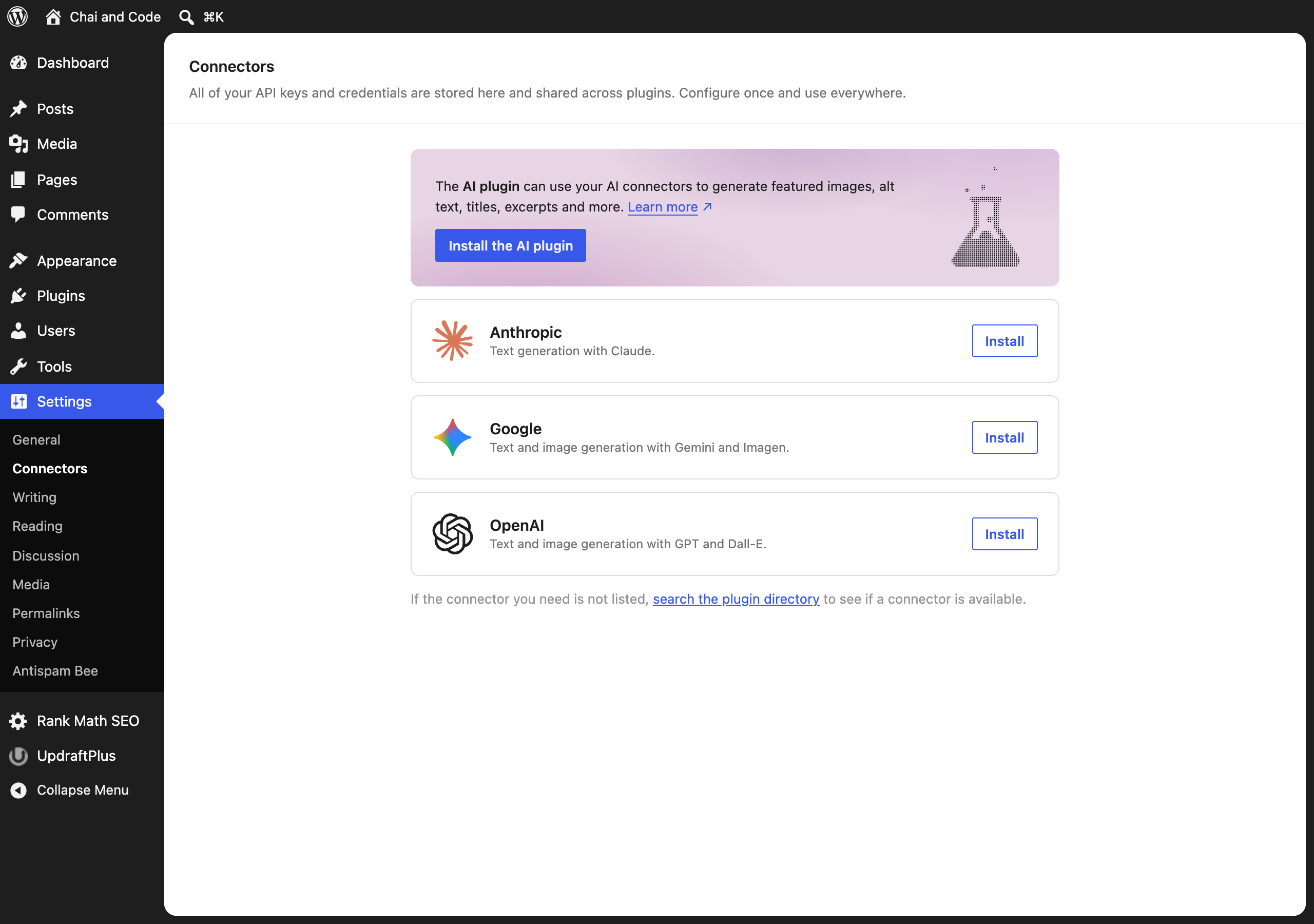
The separate AI plugin, which the Connectors screen offers to install, can suggest titles, excerpts and alt text and generate featured images, according to the 7.0 release post. You need your own API key from the provider, which is billed by them, not by WordPress.
My advice for beginners: use AI for the boring parts, first drafts of alt text, excerpt ideas, explaining an error message, and keep the actual writing yours. Google's guidance does not penalise AI assisted content as such, but a site built from text anyone could generate gives a reader, and Google, no reason to pick it. Two things that did not arrive: real time collaborative editing was pulled from 7.0 and is not on the 7.2 roadmap either. WordPress 7.2 is scheduled for 8 to 10 December 2026 with a new default theme.
How long does it take to learn WordPress?
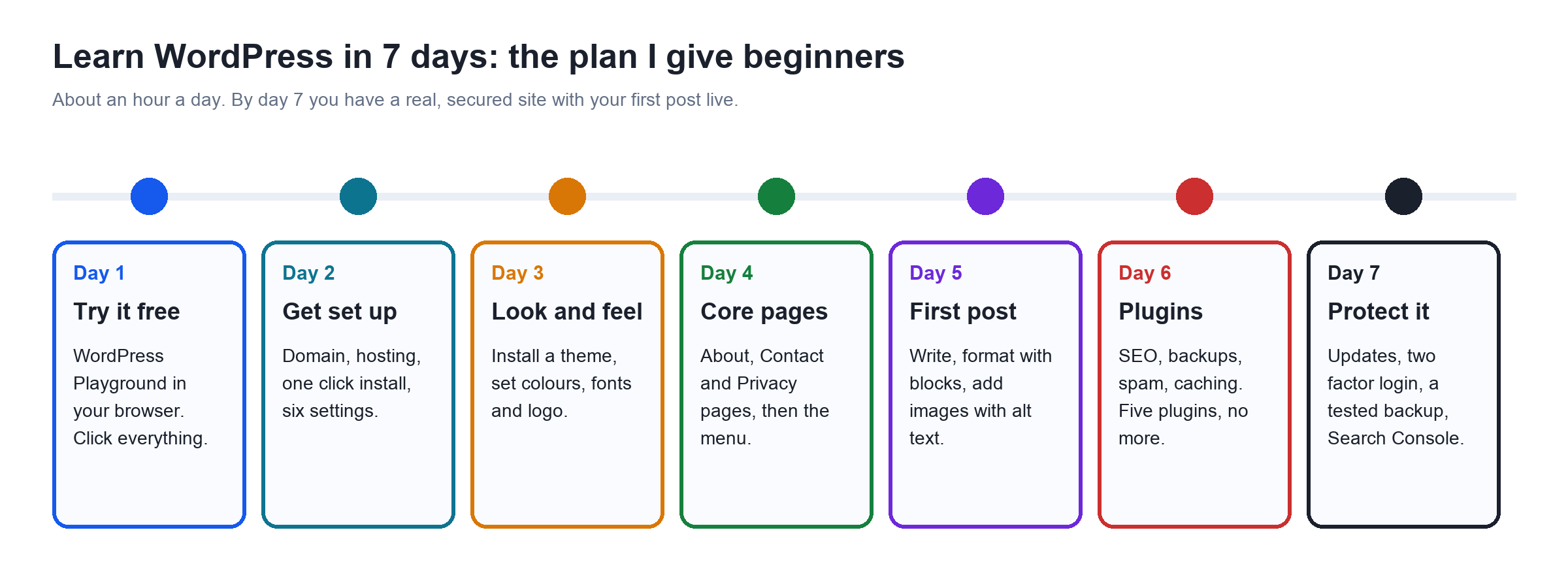
About a week to be comfortable, at an hour a day, and a few months to be genuinely good at it. You can publish a page on the first afternoon. What takes longer is judgement: which plugin, which theme setting, what to do when something breaks. That only comes from running a real site. This is the 7 day plan I give anyone who asks:
After the first week, the most useful thing you can do is keep publishing. Every post teaches you a little more about blocks, images and SEO. The official Learn WordPress site has intermediate courses for when you outgrow this tutorial, and if you ever get a scary error, my guide to the too many redirects error shows the calm, step by step way to debug WordPress.
What the 2020 version of this tutorial got wrong
Updating a tutorial properly means owning what it used to say. All of these were in the original and are gone now:
- “Choose Bluehost with my secret cheap trick.” There was no trick, just a promotional rate that renewed higher. Compare renewal prices, always.
- “Install GeneratePress and customise from Appearance, Customize.” Still valid for classic themes, but block themes now use the Site Editor, and the Customizer does not exist there.
- “Fill this form for free installation help.” The form was deleted years ago. Hosts now install WordPress for you in one click.
- “Creating a post is like MS Word.” It is not. It is built from blocks, and once you learn ten of them you can build almost any page.
- Nothing about security, backups or updates. In 2025 alone, Patchstack counted over 11,000 new WordPress vulnerabilities. A tutorial that skips updates and backups is not a complete tutorial.
The thing I would tell my 2020 self: WordPress is not hard, but it rewards habits more than knowledge. Update weekly, back up off the server, keep plugins few, and most of the horror stories never happen to you. You can read how I test and verify everything on this site if you want to know how this tutorial was checked.
Get the free WordPress tutorial PDF
Everything above condensed into a printable PDF for 2027: the 12 lesson checklist, the six day one settings, the dashboard map, the block and keyboard shortcut cheat sheet, the starter plugin stack, the security checklist, user roles and the 7 day learning plan, with screenshots from WordPress 7.1. Download it, print it, tick things off.
Key takeaways
- WordPress is free software that runs 40.2% of the web; you pay only for a domain and hosting.
- Practise in WordPress Playground first, then install on real hosting in one click.
- Change the six day one settings before you publish anything.
- Classic themes use the Customizer, block themes use the Site Editor. Both are fine.
- Learn ten blocks and the Ctrl or Cmd plus K command palette and you can build almost anything.
- Five plugins is enough to start. Update them, and keep a backup off the server.
If you get stuck on any lesson, leave a comment below with what you see on your screen. I read and answer them, and the best questions end up in the next update of this tutorial. Some links on this page are affiliate links; see my affiliate disclosure for how that works.
WordPress tutorial FAQs
Can I teach myself WordPress?
Yes. Most WordPress users are self taught. Follow a structured path like the lessons on this page or the free Beginner WordPress User course on Learn WordPress, practise on a free Playground site, and build one real site end to end. Doing beats watching.
What is the best tutorial for learning WordPress?
Use two together: a written step by step guide you can follow at your own pace, like this one and its PDF, and the official Learn WordPress courses for depth. Add a video only for the parts you find confusing, such as installation.
Is WordPress easy to learn for beginners?
Writing and publishing posts takes an afternoon to learn. Themes, plugins and settings take about a week of regular practice. The parts that take longer, like speed, security and SEO, are things you learn gradually while the site is already live.
Can ChatGPT build a WordPress website?
It can help, but it cannot do the whole job by itself. ChatGPT or Claude can write copy, suggest a structure and explain errors. WordPress 7.0 also added AI Connectors so AI plugins can draft titles, excerpts and alt text inside your dashboard. You still choose the hosting, theme and plugins, and you are responsible for checking every word before it is published.
Is WordPress outdated in 2026?
No. WordPress runs 40.2% of all websites according to W3Techs, version 7.0 added built in AI infrastructure in May 2026, and 7.1 followed in August. It is the most used content management system by a wide margin.
Can you give me an example of a WordPress website?
Bloggertutor, the site you are reading, runs on WordPress 7.1.2 with the Blocksy theme. The official WordPress Showcase at wordpress.org/showcase lists many more, from news publishers to universities and online stores.
Can I learn WordPress in 3 days?
You can learn the basics in 3 days: install it, pick a theme, create pages and publish a post. Give yourself 7 days to also cover plugins, security and backups properly, which is the plan in this guide.
What are WordPress widgets?
Widgets are small content boxes, like recent posts or a search bar, placed in a sidebar or footer. Classic themes manage them under Appearance, Widgets. Block themes replaced widgets with blocks you place directly in templates using the Site Editor.
Is WordPress totally free to use?
The WordPress software is free and open source. To run a site with your own domain you pay for a domain and hosting, which starts at roughly Rs 149 or $2 to $3 a month on a long term. Premium themes and plugins are optional.
What is WordPress?
WordPress is free, open source software for building websites and blogs. You install it on hosting, then manage everything, from posts to design, through a dashboard in your browser without writing code.
What is the difference between WordPress.com and WordPress.org?
WordPress.org gives you the free software to install on hosting you rent, with full control. WordPress.com is a hosted service run by Automattic that handles hosting for you, with plugins available on paid plans only.
Do I need to know coding to use WordPress?
No. Everything in this tutorial is done with clicks. HTML and CSS help later for small tweaks, and PHP only matters if you want to build themes or plugins yourself.
How many plugins should a WordPress site have?
There is no fixed limit, but a new site needs about five: SEO, backups, caching, forms and security. One well coded plugin is better than three that overlap. Delete any you are not using.
What is the latest version of WordPress?
WordPress 7.1.2, released on 22 September 2026 as a security release. WordPress 7.2 is scheduled for 8 to 10 December 2026.
Is there a free WordPress tutorial PDF?
Yes. The free PDF version of this tutorial is linked at the top and bottom of this page. It needs no email address and includes the setup checklist, the day one settings, the plugin list, the security checklist and the 7 day plan.