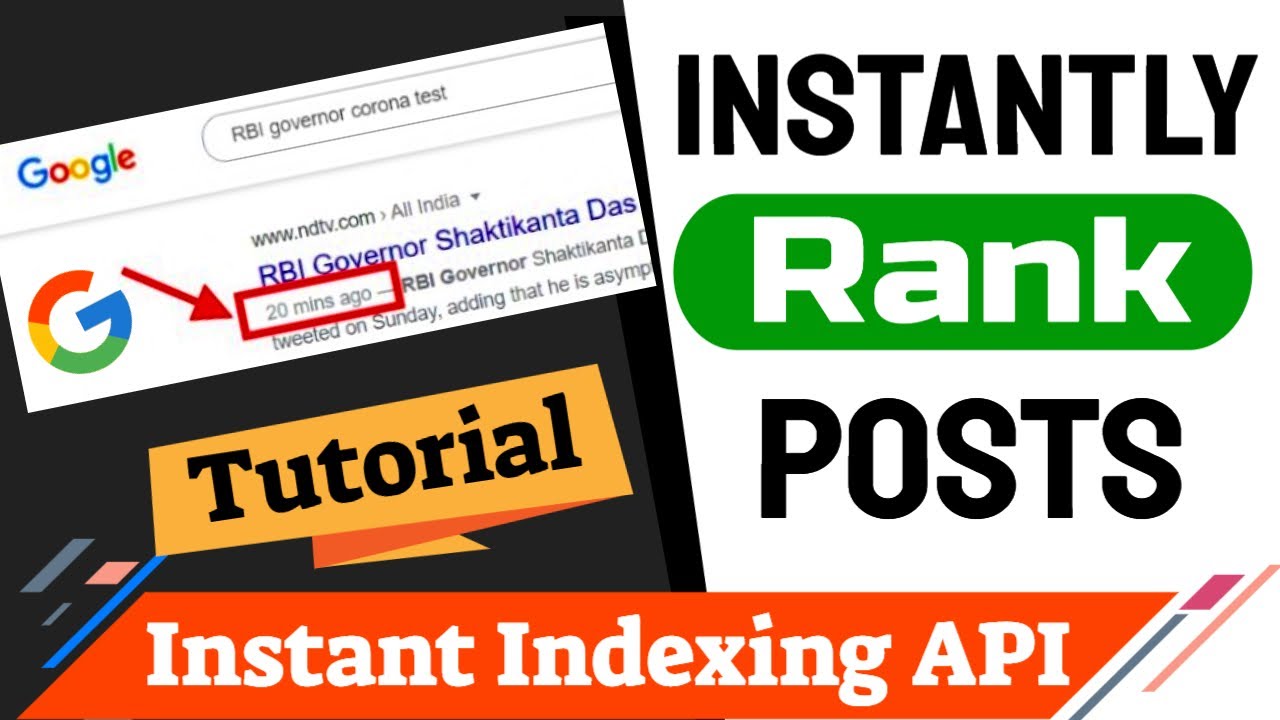
Rank Math Instant Indexing is the fastest way to tell search engines that you have published or updated a post, instead of waiting days for a normal crawl. There are two separate features with almost the same name though, and most guides online still confuse them. This post covers both, and tells you honestly which one you should actually use in 2026.

Important 2026 Update Before You Start
Google's Indexing API is officially limited to pages with JobPosting or BroadcastEvent markup. It was never meant for ordinary blog posts. Google's Search Relations team restated this publicly in 2025, and quota increases are now approved only for sites that genuinely use that markup.
Rank Math says the same thing on its own plugin page: “Google recommends that you use the Indexing API ONLY for Job Posting and Live Streaming websites. However, it works on any type of website and many of our users have seen great results already. Please proceed with caution.”
So here is the short version. If you want a sanctioned, zero risk way to get indexed faster, use IndexNow, which is built into Rank Math free and covers Bing and Yandex. If you still want the Google Indexing API route, the full setup is further down, with the caveats spelled out.
What Instant Indexing Actually Does
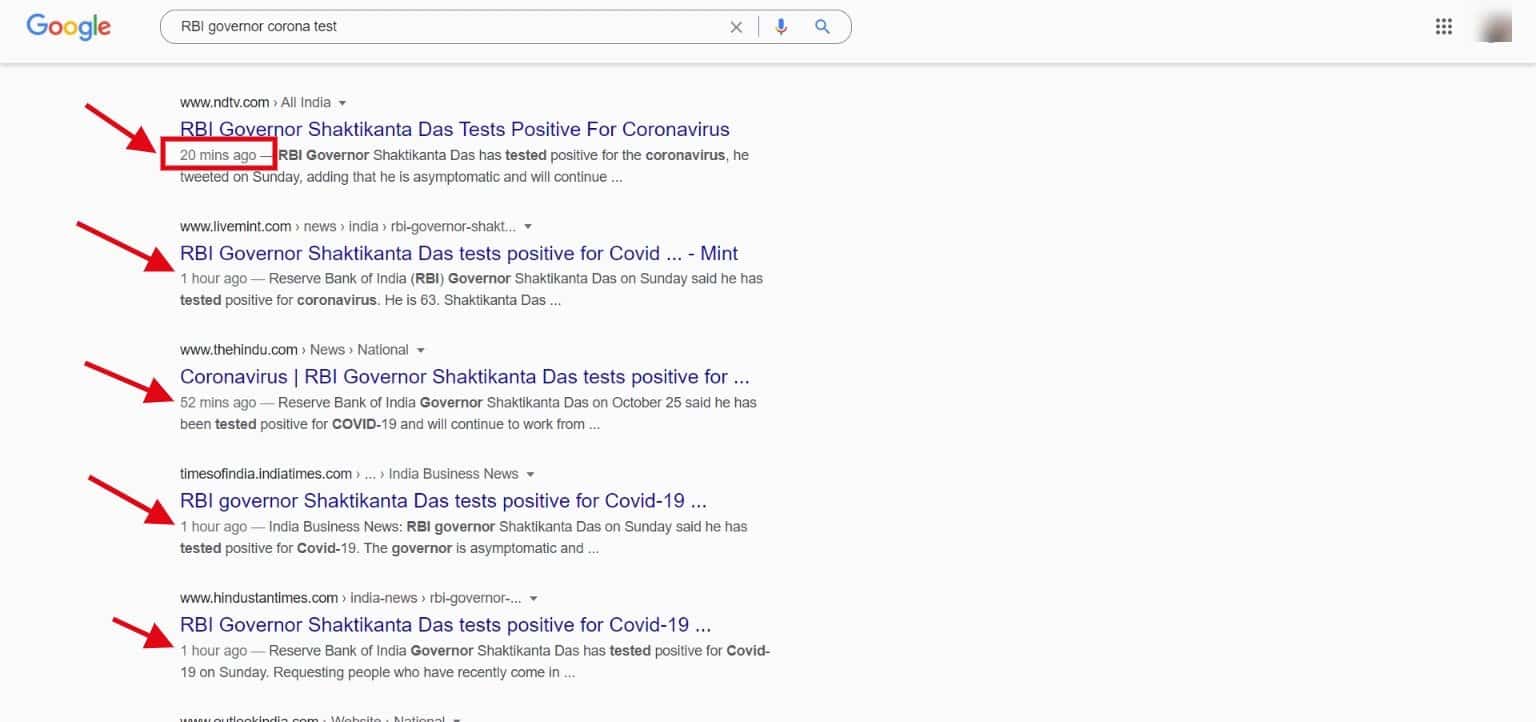
Normally a search engine finds your new post by crawling your sitemap or following a link, which can take anywhere from a few hours to several weeks on a small site. Instant indexing flips that around: your site pings the search engine the moment you hit publish, so the crawler comes to you.
- Faster first crawl, which matters most for time sensitive posts like news, deals and live updates.
- Faster re-crawl after edits, so a corrected price or updated year shows in search results sooner.
- Faster removal when you delete a post, instead of leaving a dead result in the index.
What it does not do is force a page to rank, or force Google to keep a page indexed. It is a crawl request, not an indexing guarantee. Thin or duplicate content will still be dropped.
The Two Rank Math Indexing Features, Side by Side
This is the part almost every older tutorial gets wrong, including the earlier version of this post. They are two different things:
| IndexNow (Instant Indexing module) | Google Indexing API (separate plugin) | |
|---|---|---|
| Where it lives | Built into Rank Math Free | Separate free plugin, Instant Indexing for Google |
| Search engines | Bing, Yandex, Naver, Seznam | Google only |
| Setup time | About 2 minutes | About 20 minutes, needs Google Cloud |
| API key | Auto generated and hosted by Rank Math | You create a service account and JSON key |
| Officially allowed for blogs? | Yes | No, JobPosting and BroadcastEvent only |
| Cost | Free | Free |
| Who should use it | Everyone | Job boards and live stream sites |
Method 1: Set Up IndexNow in Rank Math (Free, 2 Minutes)
IndexNow is an open protocol from Microsoft and Yandex. You submit a URL once and every participating search engine is told about it. Rank Math generates and hosts the required API key for you automatically, so there is nothing technical to configure.
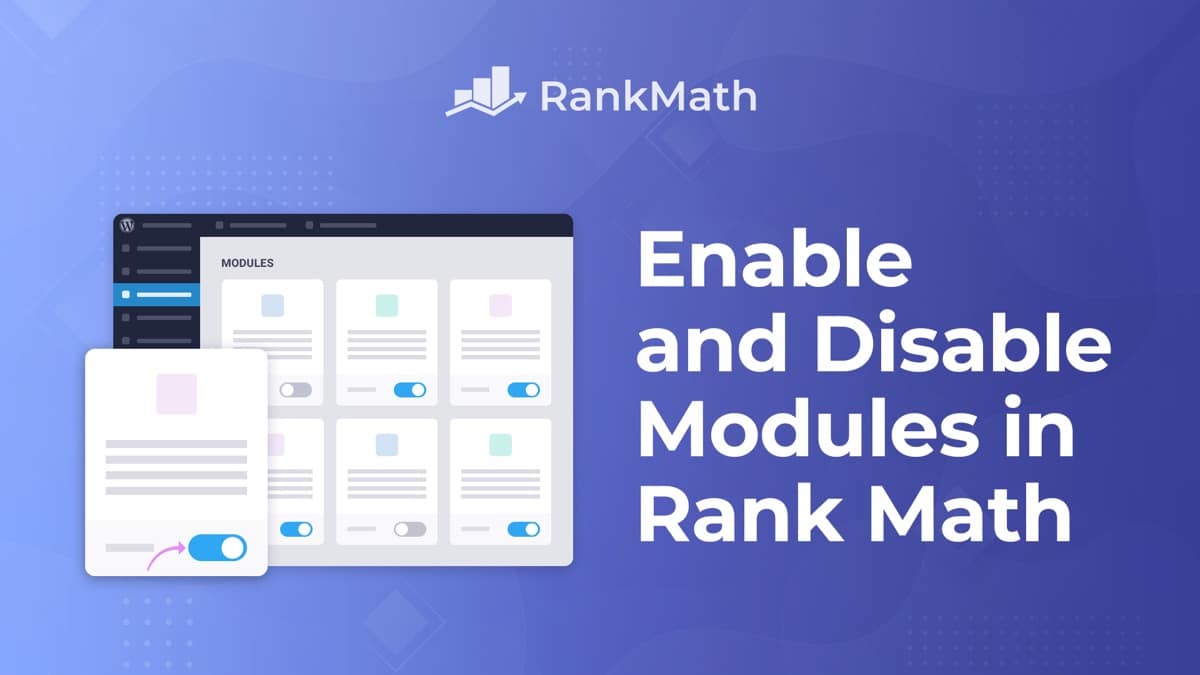
- Go to WordPress Dashboard, then Rank Math SEO.
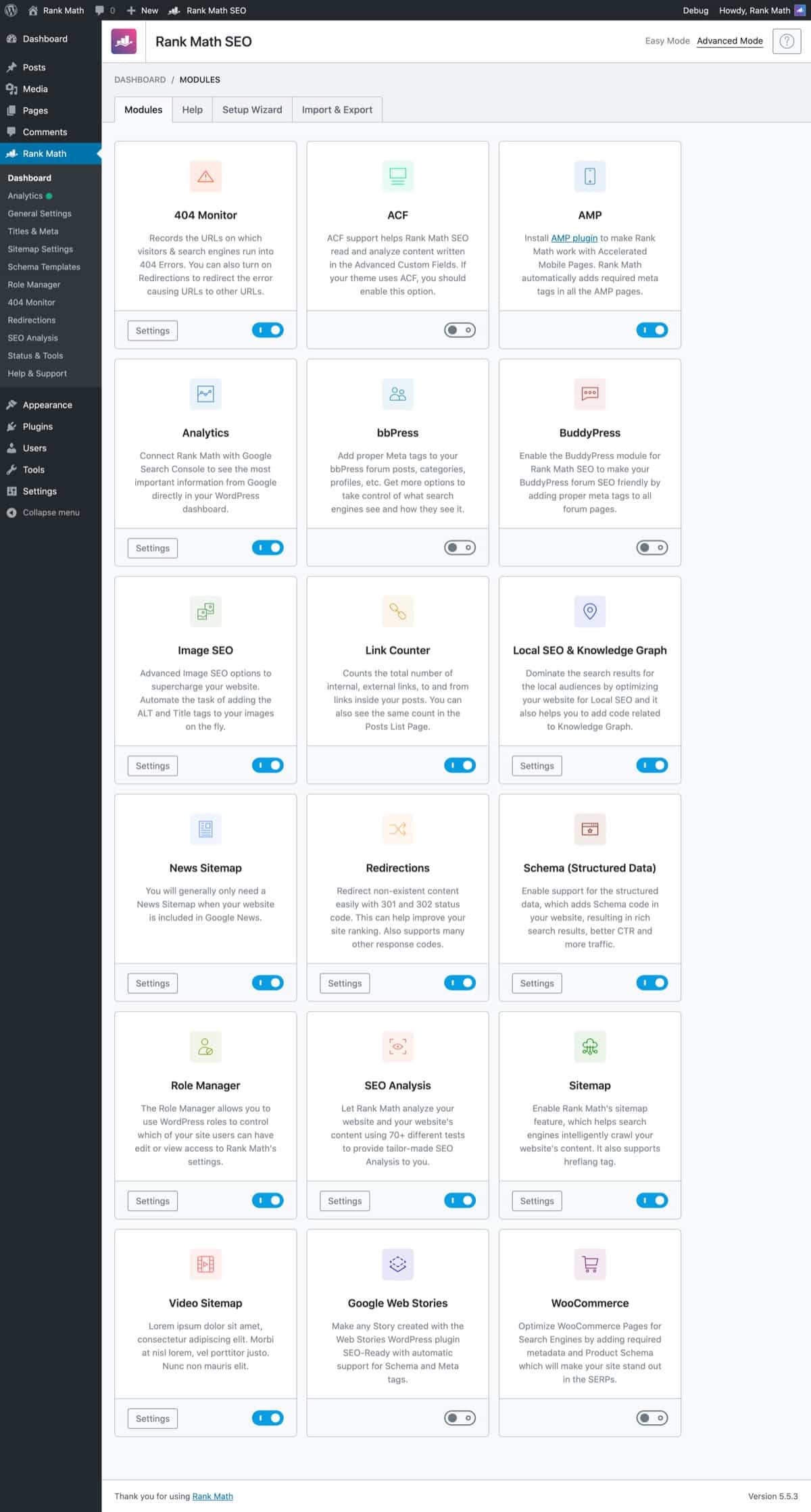
- Enable the Instant Indexing module.
- Open Rank Math SEO, then Instant Indexing, then Settings.
- Tick the post types you want submitted automatically, usually Posts and Pages.
- Confirm Rank Math has generated an API Key, then click Save Changes.
That is the whole setup. From now on Rank Math submits every new or updated post automatically. One useful detail: it will not submit URLs set to NoIndex, so you do not have to exclude them manually.
Submitting URLs Manually With IndexNow
- In batch: Rank Math SEO, then Instant Indexing, then Submit URLs. Paste one URL per line.
- A single post: hover the post in the Posts list and choose Instant Indexing: Submit Page.
- In bulk: select multiple posts in the Posts list and use the Instant Indexing bulk action.
Method 2: Google Indexing API With the Instant Indexing Plugin
Read This First
This method uses Google's Indexing API, which Google restricts to JobPosting and BroadcastEvent pages. Plenty of bloggers use it anyway because the endpoint accepts any URL and returns a success response, but Google validates later at crawl time and reserves the right to ignore submissions from accounts that misuse it. Use it knowingly, and do not treat it as a replacement for good sitemaps and internal linking.
If you run a job board or a live streaming site, this is exactly the tool you want, and the setup below is the complete process. You will need the free Instant Indexing for Google plugin, which is separate from Rank Math itself.
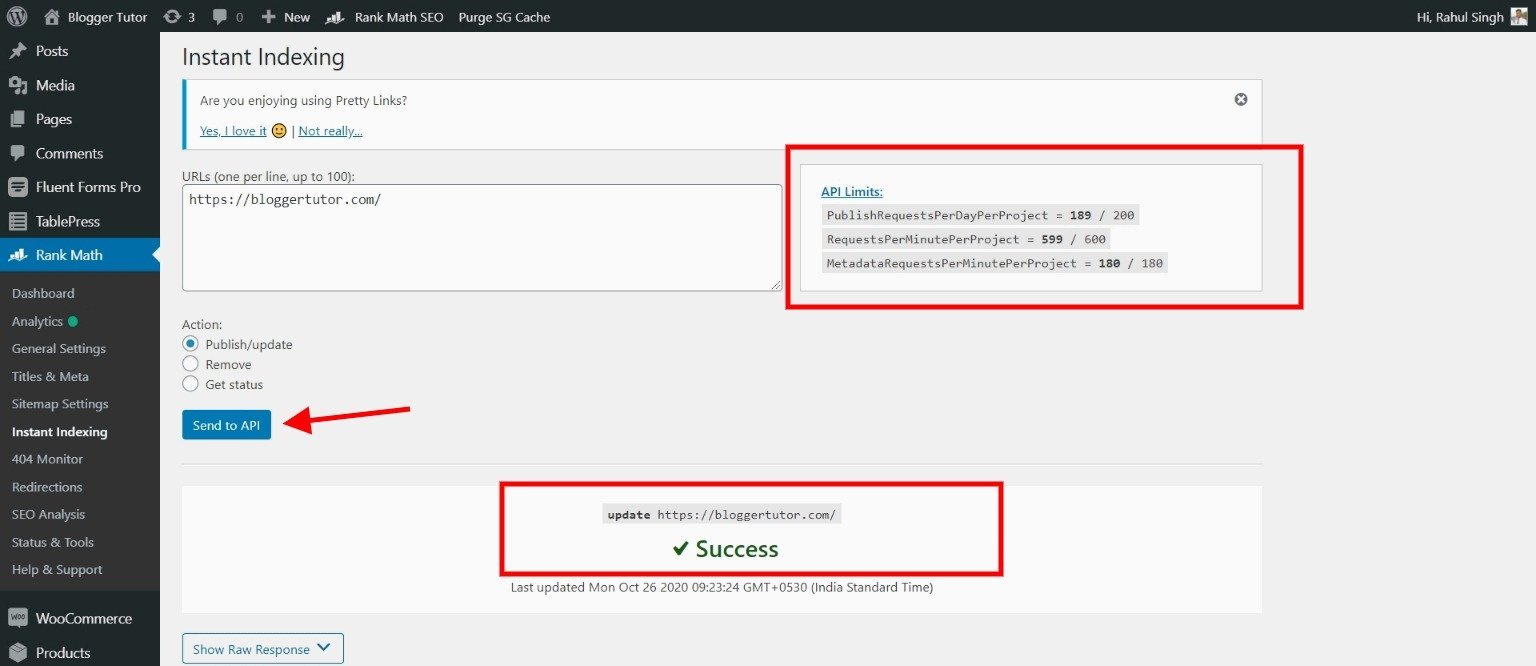
Full setup for the Google Indexing API using the Rank Math Instant Indexing plugin.
u003cstrongu003eInstall the Instant Indexing pluginu003c/strongu003e

Install and activate u003cemu003eInstant Indexing for Google by Rank Mathu003c/emu003e from the WordPress plugin repository. It is free and works alongside any SEO plugin.
u003cstrongu003eCreate a Google Cloud projectu003c/strongu003e

Open the Google Cloud Console and create a new project. Use the same Google account that already has your domain verified in u003ca href=u0022https://bloggertutor.com/google-search-console-verification/u0022u003eGoogle Search Consoleu003c/au003e.
u003cstrongu003eEnable the Indexing APIu003c/strongu003e

Inside the project, search the API library for u003cemu003eIndexing APIu003c/emu003e and enable it for your project, then continue to the credentials step.
u003cstrongu003eCreate a service accountu003c/strongu003e

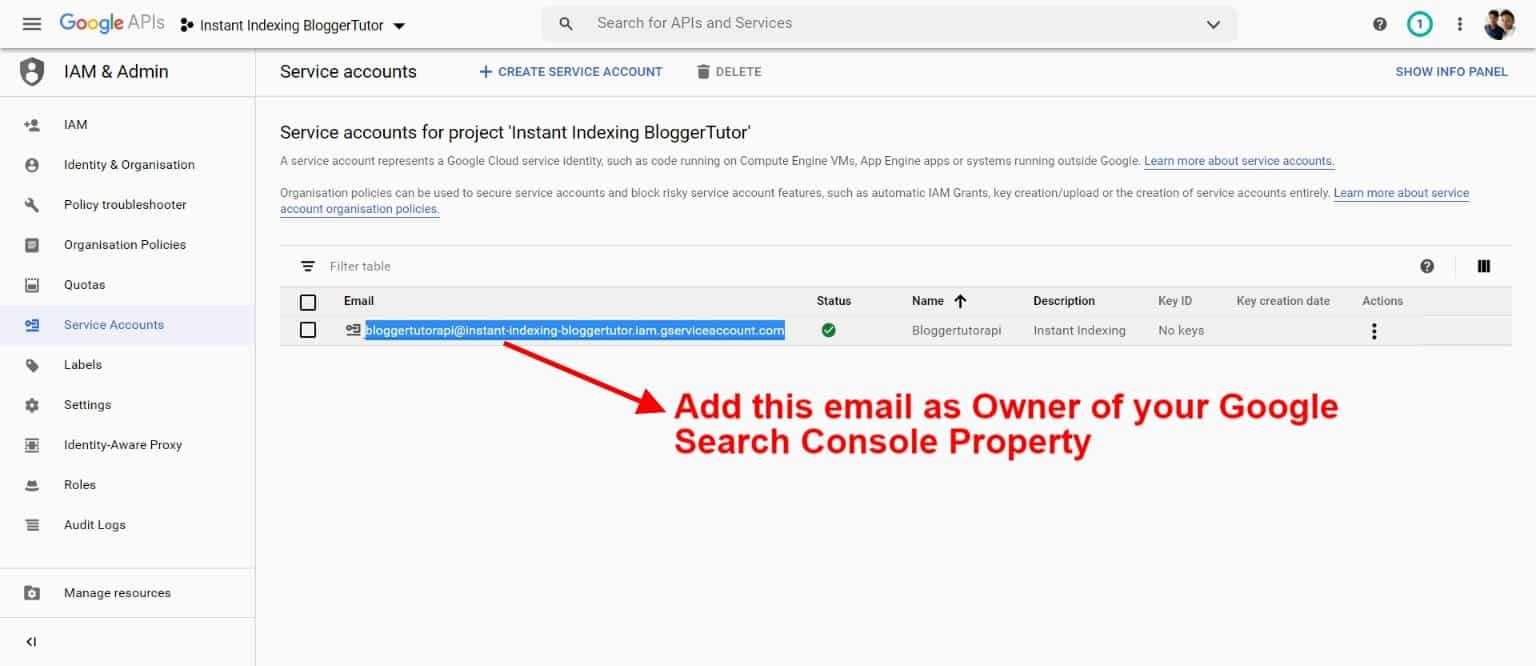
Go to IAM and Admin, then Service Accounts, and create a service account. Give it a name, set the role to u003cstrongu003eOwneru003c/strongu003e, and copy the full service account ID, which looks like an email address. You need it in the next step.
u003cstrongu003eAdd the service account as a property owneru003c/strongu003e

In Google Search Console open Settings, then Users and permissions. Add the service account ID you copied as an u003cstrongu003eOwneru003c/strongu003e of the property. Without this the API will reject every request.
u003cstrongu003eCreate and download the JSON keyu003c/strongu003e

Back on the Service Accounts page, open the three dot menu next to your account, choose Manage keys, then Add key, then Create new key. Pick u003cstrongu003eJSONu003c/strongu003e and download the file. Treat this file like a password and never commit it anywhere public.
u003cstrongu003ePaste the key into the pluginu003c/strongu003e

In WordPress go to u003cemu003eRank Math, then Instant Indexing, then Settingsu003c/emu003e, paste the contents of the JSON file, choose the post types to submit, and save. Publishing or updating a post will now ping Google automatically.
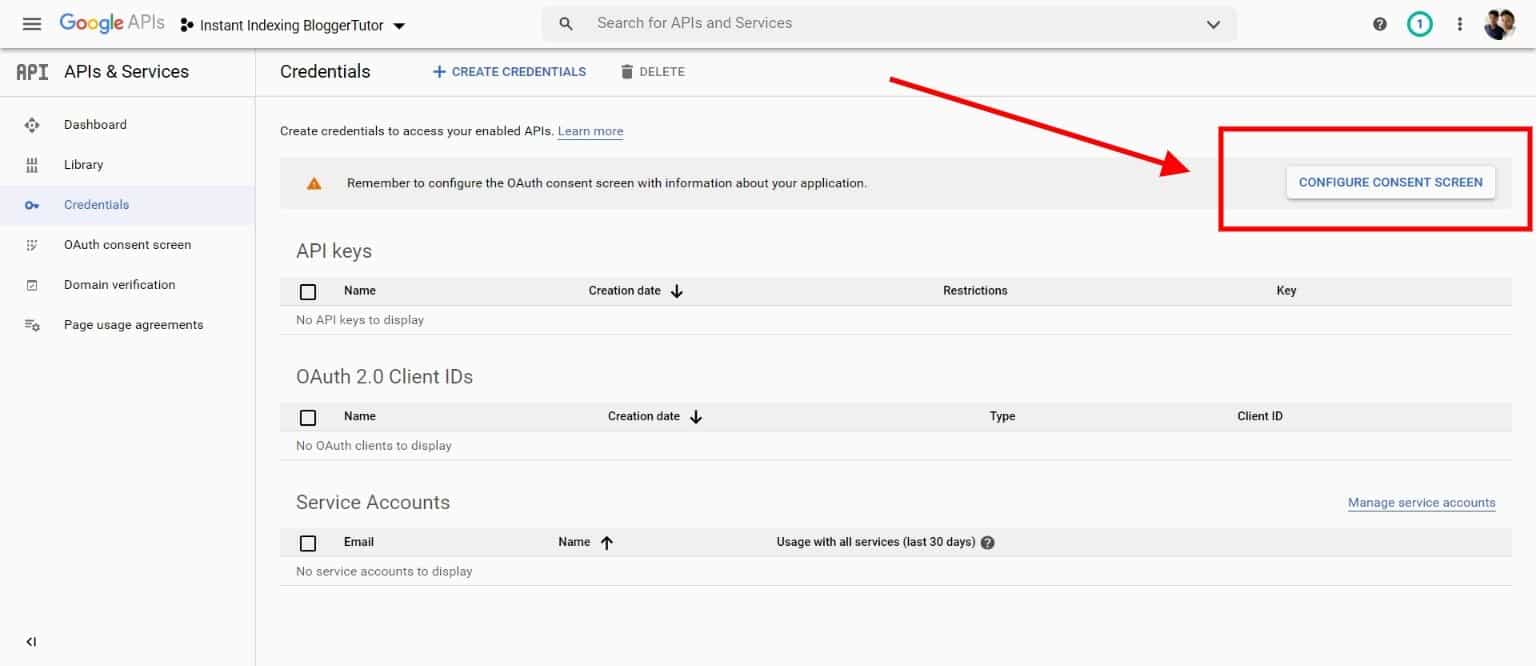
Note on the screenshots below. These were captured when I first wrote this guide and Google has redesigned the Cloud Console since. The steps and the order are still correct, but button placement and labels will look different from what you see on screen today.
Video Walkthrough
How to Check Whether It Actually Worked
- Rank Math history: Rank Math SEO, then Instant Indexing, then History shows every submission and its response.
- Google Search Console: paste the URL into the URL Inspection tool. It will tell you whether the page is indexed and when it was last crawled.
- Bing Webmaster Tools: the URL Inspection and IndexNow sections confirm Bing received your submission.
- A quick site search: search
site:yourdomain.com/your-post-slug. Crude, but it tells you if the page is in the index at all.
A successful API response only means the request was accepted. It is not a promise the page will be indexed or kept in the index.
Common Instant Indexing Errors and How to Fix Them
| Error you see | What it actually means | Fix |
|---|---|---|
Permission denied | The service account is not an owner of the Search Console property | Add the service account ID as an Owner in Search Console, then wait a few minutes |
Invalid JSON key / parse error | The key file was pasted partially or got reformatted | Re-download the JSON key and paste the entire file contents, including the braces |
Quota exceeded | You hit the daily publish request limit | Space submissions out. Quota increases are only granted to JobPosting and BroadcastEvent sites |
| Submission works but page is not indexed | The crawl request succeeded, indexing was declined | This is a content quality or duplication signal, not an API problem. Improve the page |
| IndexNow key 404 | The hosted key file is not reachable | Re-save Instant Indexing settings so Rank Math regenerates the key, and check no security plugin blocks the file |
| Nothing submits automatically | The post type is not selected, or the post is NoIndex | Tick the post type in Instant Indexing settings and confirm the post is set to Index |
What Actually Gets Posts Indexed Faster
Instant indexing is a nudge, not a fix. If your posts are slow to index or drop out of the index, these move the needle far more, and none of them carry any policy risk:
- A clean XML sitemap submitted in Search Console, with no noindex or redirected URLs in it.
- Internal links from posts that already rank. This is the single most reliable way to get a new post crawled.
- Publishing consistently. Crawl frequency follows update frequency.
- Fixing crawl errors in Search Console so budget is not wasted on dead URLs.
- Genuinely useful content. Indexing refusals are usually a quality signal, not a technical one.
- Connect Search Console to Rank Math so you can see index status inside WordPress.
- Keep your robots.txt sane and do not block anything you want crawled.
- Avoid orphan pages with no internal links pointing at them.
Rank Math Pro (Recommended)
Instant Indexing and IndexNow are free in Rank Math. If you want the parts that actually help you rank once you are indexed, keyword rank tracking, 840+ schema types, advanced redirections and the analytics dashboard, that is Rank Math Pro. It starts at $7.99/month billed annually and covers unlimited personal sites.
Through the official offer page you also get double the limits at the same price, which means 1,000 tracked keywords on Pro instead of 500. There is no coupon code to enter.
Rank Math Instant Indexing FAQs
Is Instant Indexing included in Rank Math or a separate plugin?
Both, and this is where most guides go wrong. IndexNow submission to Bing and Yandex is built into Rank Math Free as the Instant Indexing module. The Google Indexing API needs a separate free plugin called Instant Indexing for Google by Rank Math.
Does Rank Math Instant Indexing work with Google?
Only through the separate Instant Indexing for Google plugin, which uses Google's Indexing API. The module built into Rank Math submits to IndexNow engines, which are Bing, Yandex, Naver and Seznam, not Google.
Is using the Google Indexing API for blog posts against the rules?
Google documents the Indexing API as supporting only JobPosting and BroadcastEvent pages, so using it for ordinary blog posts is outside the documented scope. It usually still works because validation happens later at crawl time, but Google can ignore submissions from accounts that misuse it.
Will instant indexing make my post rank higher?
No. It only asks a search engine to crawl the page sooner. Ranking still depends on content quality, relevance and links. The benefit is speed to first crawl, which matters for time sensitive posts.
How long does indexing take after submitting?
With IndexNow, Bing often picks pages up within minutes to a few hours. With the Google Indexing API, a crawl can happen within minutes, but actual indexing can still take days or never happen if the page does not meet quality thresholds.
Do I need Rank Math Pro for Instant Indexing?
No. Both the IndexNow module and the Google Instant Indexing plugin are completely free. Rank Math Pro adds rank tracking, advanced schema and analytics, which are separate features.
What is IndexNow and which search engines support it?
IndexNow is an open protocol created by Microsoft and Yandex. You submit a URL once and it is shared with every participating engine. Bing, Yandex, Naver and Seznam currently support it. Google has not adopted it.
Do I need to create an API key for IndexNow?
No. Rank Math generates the key automatically, hosts it on your domain and serves it to search engines for verification. There is nothing for you to create or upload.
Why does my Instant Indexing submission say permission denied?
The service account has not been added as an Owner of your property in Google Search Console. Copy the service account ID, add it under Settings then Users and permissions with the Owner role, and try again.
Can I submit URLs in bulk?
Yes. Go to Rank Math SEO, then Instant Indexing, then Submit URLs and paste one URL per line. You can also select several posts in the Posts list and use the Instant Indexing bulk action.
Does Instant Indexing submit noindex pages?
No. Rank Math deliberately skips URLs set to NoIndex, so you do not need to exclude them manually.
Is there a daily limit on indexing requests?
Google's Indexing API has a default daily quota per project. Quota increases are only approved for sites that genuinely use JobPosting or BroadcastEvent markup. IndexNow is far more generous but still expects reasonable use.
Does instant indexing help with deleted posts?
Yes, and this is one of its better uses. Submitting a removed URL tells the search engine to re-crawl and drop it, which clears dead results out of search faster than waiting.
What should I use if I just run a normal blog?
Enable the IndexNow module in Rank Math, submit a clean XML sitemap in Search Console, and build internal links from posts that already rank. That combination gets you almost all of the available speed with none of the policy risk.
More Rank Math Guides on Blogger Tutor
- Rank Math Coupon Code, All Live and Expired Sales
- Rank Math Review, Is Rank Math Pro Actually Worth It?
- Rank Math vs SEOPress, Which Plugin Is Worth Your Money?
- Rank Math vs Yoast, Which SEO Plugin Is Actually Better?
- How to Switch From Yoast to Rank Math Without Losing Rankings
- How to Verify Your Site in Google Search Console
- Top 10 On Page SEO Tips to Rank on Google
Disclosure: I am part of the Rank Math affiliate programme and earn a small commission if you buy through the links on this page, at no extra cost to you. The Instant Indexing module and plugin covered in this guide are both free. Last verified 21 September 2026. You can read exactly how I test, verify and update everything on this site.