Rank Math vs Yoast 2026, Which SEO Plugin Is Actually Better?

Tutorials & Insights
Rank Math vs Yoast is still the first decision most WordPress owners make, and almost every comparison you will read was written by someone selling one of them. I have run both on this blog since 2020, and I moved from Yoast to Rank Math in 2021 without losing rankings. Below is what separates them in September 2026, checked against both vendors' current pricing pages and WordPress.org's live plugin data. You will not find a five year old feature chart here.
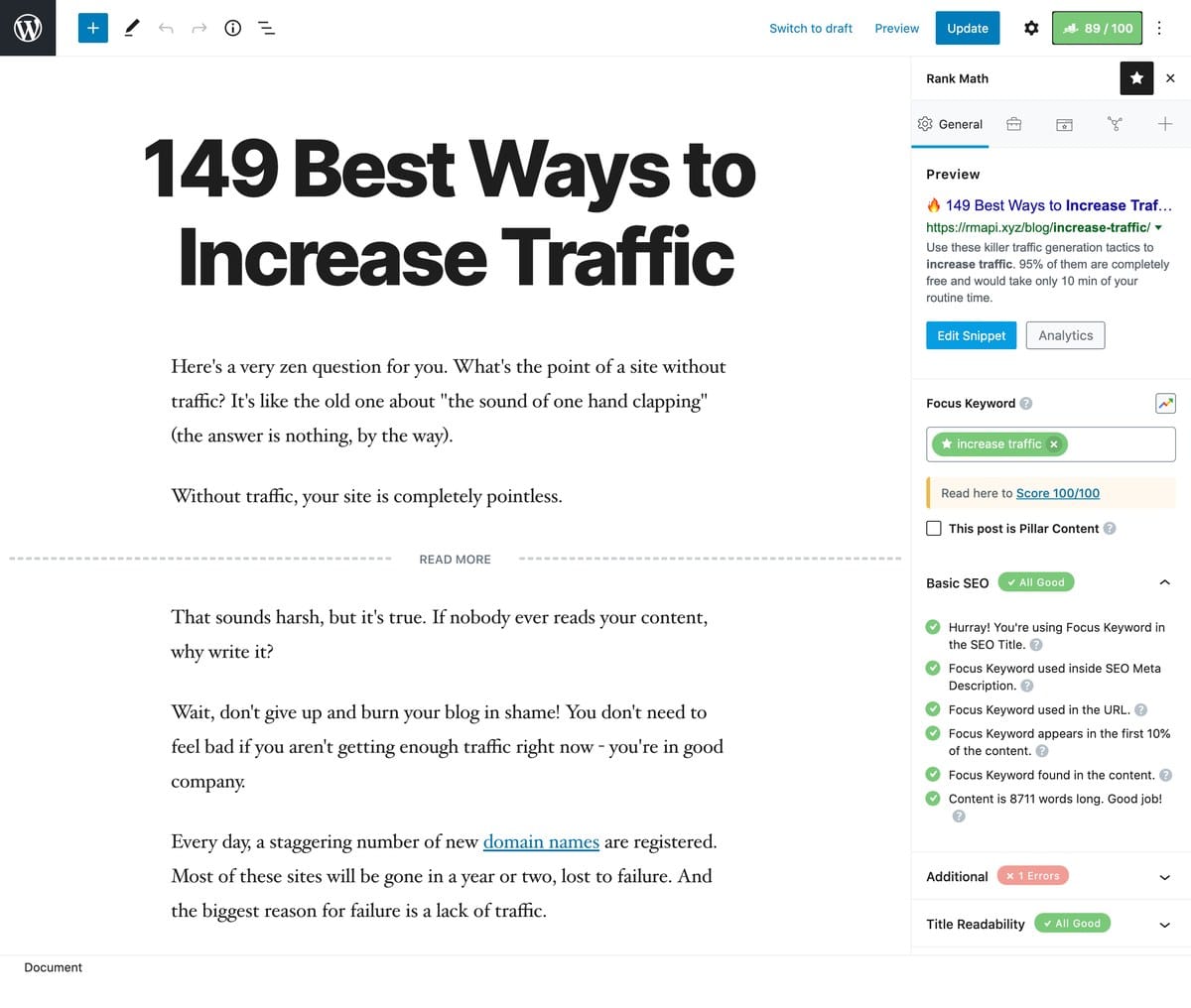
Pick Rank Math if you want the most SEO per dollar. The free plugin includes redirects, a 404 monitor, unlimited focus keywords and schema that Yoast either charges for or does not offer at all, and PRO covers unlimited personal sites for $95.88 a year.
Pick Yoast if you run one important site, you want the most polished writing guidance and 24/7 human support in the box, and you will really use the Google Docs workflow and the bundled Local, Video and News SEO plugins. That costs $118.80 a year for one site.
For a blogger or anyone running more than one website, Rank Math wins on value and it is not close. For a single business site with a content team, Yoast is a defensible choice.
Everything below is from the WordPress.org plugin directory and the two official pricing pages, checked on 16 November 2026.
| Rank Math | Yoast SEO | |
|---|---|---|
| Active installs | 4 million plus | 10 million plus |
| Rating on WordPress.org | 96 out of 100 from 7,506 reviews | 96 out of 100 from 27,819 reviews |
| Current version | 1.0.278 | 28.5 |
| Plugin download size | about 3.6 MB | about 5.0 MB |
| Paid plan entry price | $7.99/mo billed yearly, $95.88 | $9.90/mo billed yearly, $118.80 |
| Sites per paid licence | Unlimited personal sites | 1 site |
| Focus keywords, free | Unlimited | 1 per page |
| Focus keywords, paid | Unlimited | Up to 5 per page |
| Redirection manager | Free | Premium only |
| 404 monitor | Free | Not included |
| Keyword rank tracking | PRO, 500 keywords | Not included |
| Schema types | 18 free, 840 plus in PRO | Built in, plus schema aggregation |
| Built in AI | Content AI, AI Link Genius | AI titles and descriptions, Content Planner |
| Google Docs add on | No | Yes, one seat included |
Both plugins sit at 96 out of 100 on WordPress.org, so anyone telling you Rank Math has better reviews is stretching it. Yoast also has more than twice the installs, which helps when you hire a developer who has to work in your admin.
Price settles this for most people, so here are the numbers instead of a vague “Rank Math is cheaper”.
| Plan | Yearly cost | Sites covered | Cost per site if you run 3 sites |
|---|---|---|---|
| Yoast SEO Premium | $118.80 | 1 | $356.40 |
| Rank Math PRO | $95.88 | Unlimited personal sites | $95.88 |
| Rank Math Business | $299.88 | 100 client sites | $95.88 is enough, no need |
If you only ever run one website the gap is $22.92 a year, which is close enough to ignore. The moment you add a second site, a client site or a project blog, Yoast doubles and Rank Math does not move. That single licensing difference is why most multi site owners switch.
Yoast Premium in 2026 now bundles the Local SEO, Video SEO and News SEO plugins that used to be sold separately. If you need those, $118.80 beats the old add on pricing and the comparison gets a lot closer.
On the Rank Math side, buying through the official offer page doubles the keyword and site allowances at the same price, so PRO tracks 1,000 keywords instead of 500. Neither vendor discounts renewals.
Full breakdown of every Rank Math sale, past and present, is in my Rank Math coupon and discount guide.
Most people never pay for either plugin, so the free versions are where this fight is really decided. Rank Math built its whole reputation here.
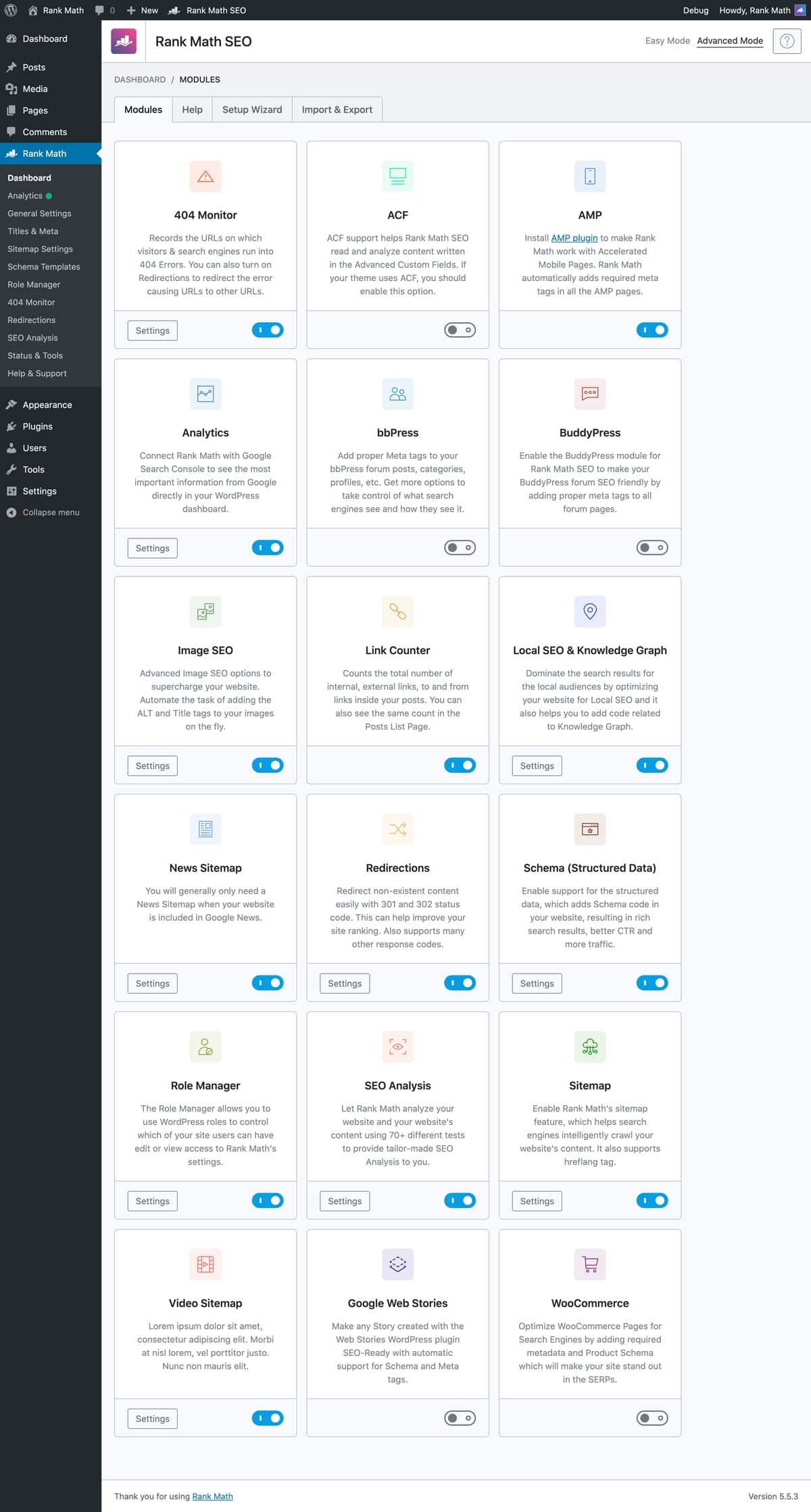
| Free feature | Rank Math Free | Yoast SEO Free |
|---|---|---|
| Focus keywords per post | Unlimited | 1 |
| Redirection manager | Yes, with 301, 302, 307, 410 and 451 | No, Premium only |
| 404 monitor | Yes, with a full log | No |
| Internal linking suggestions | Yes | No, Premium only |
| Schema types | 18 pre defined including FAQ and HowTo | Article, Product and site schema |
| Google Search Console integration | Yes, inside the dashboard | Limited |
| Google Analytics 4 integration | Yes | No |
| Readability analysis | Yes | Yes, and more developed |
| XML sitemaps | Yes | Yes |
| Role manager | Yes | No |
| Import from the other plugin | Yes, one click from Yoast | Yes, from Rank Math |
| Instant indexing for Bing and Yandex | Yes, free module | No |
The redirection manager is the one that surprises people. Yoast keeps redirects behind the $118.80 Premium wall, while Rank Math hands you a full manager in the free plugin.
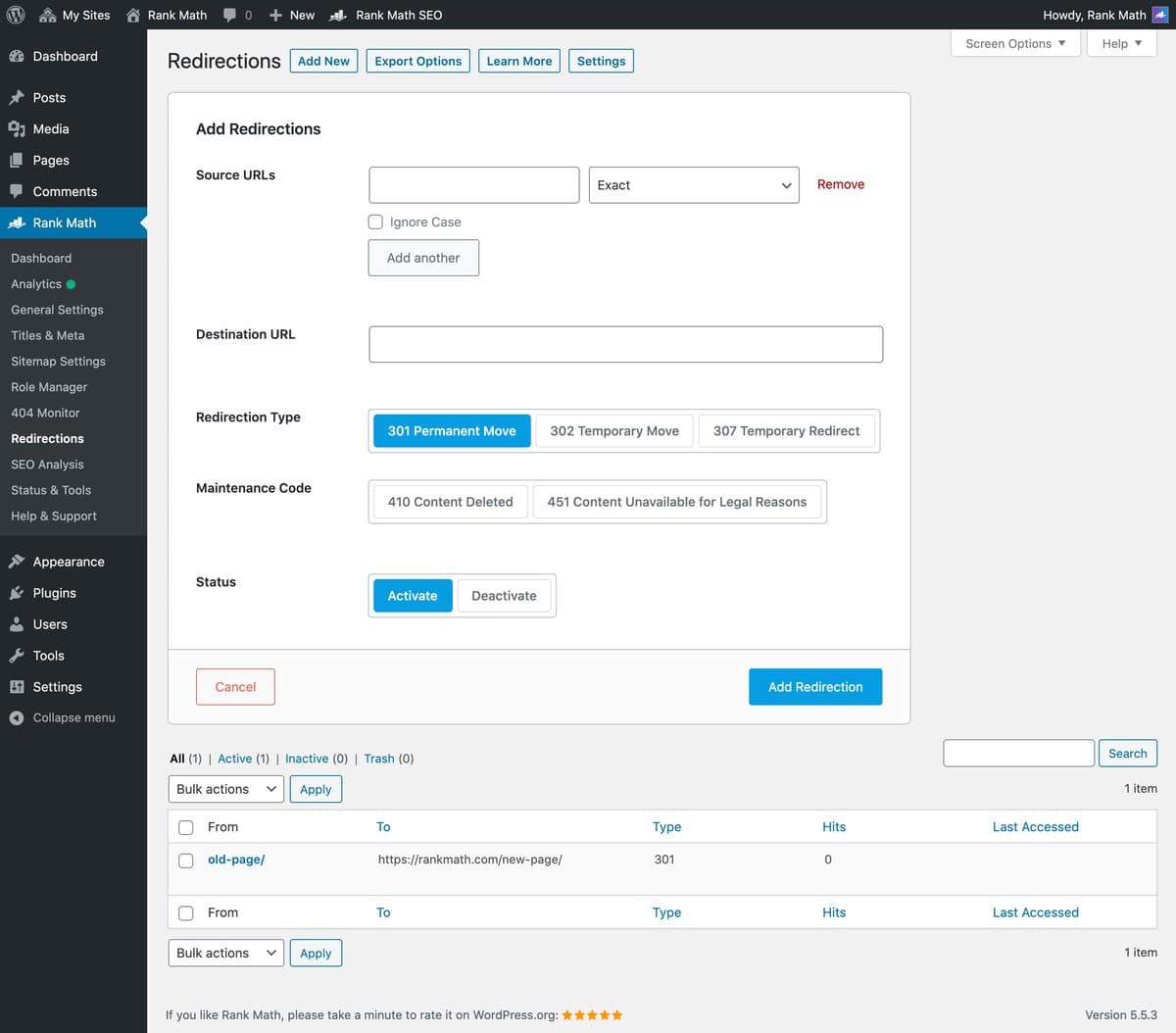
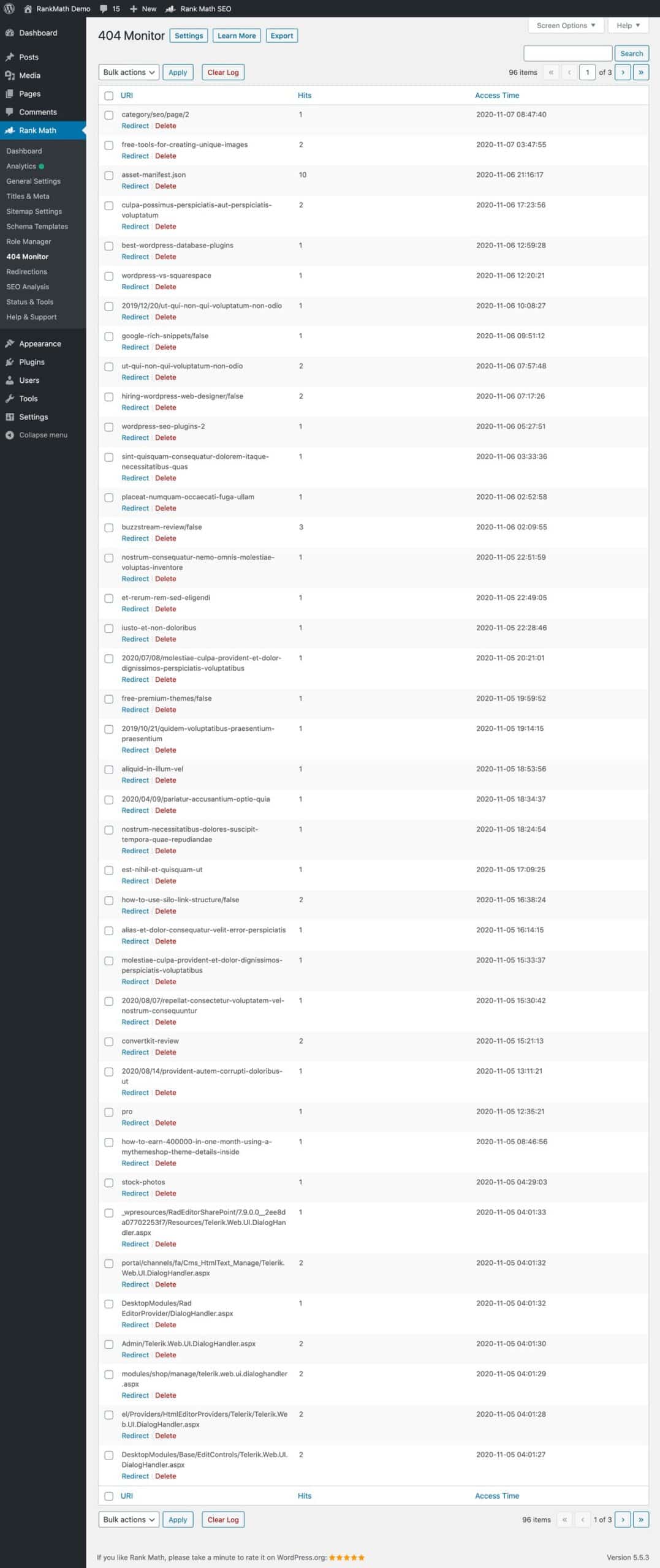
The 404 monitor is the other free win. Every broken URL a visitor or a bot hits gets logged with the referrer, so you can fix or redirect it in two clicks. Yoast has no equivalent at any price, free or Premium.
Both plugins output structured data automatically, and both do it competently. The difference is how far you can push it.
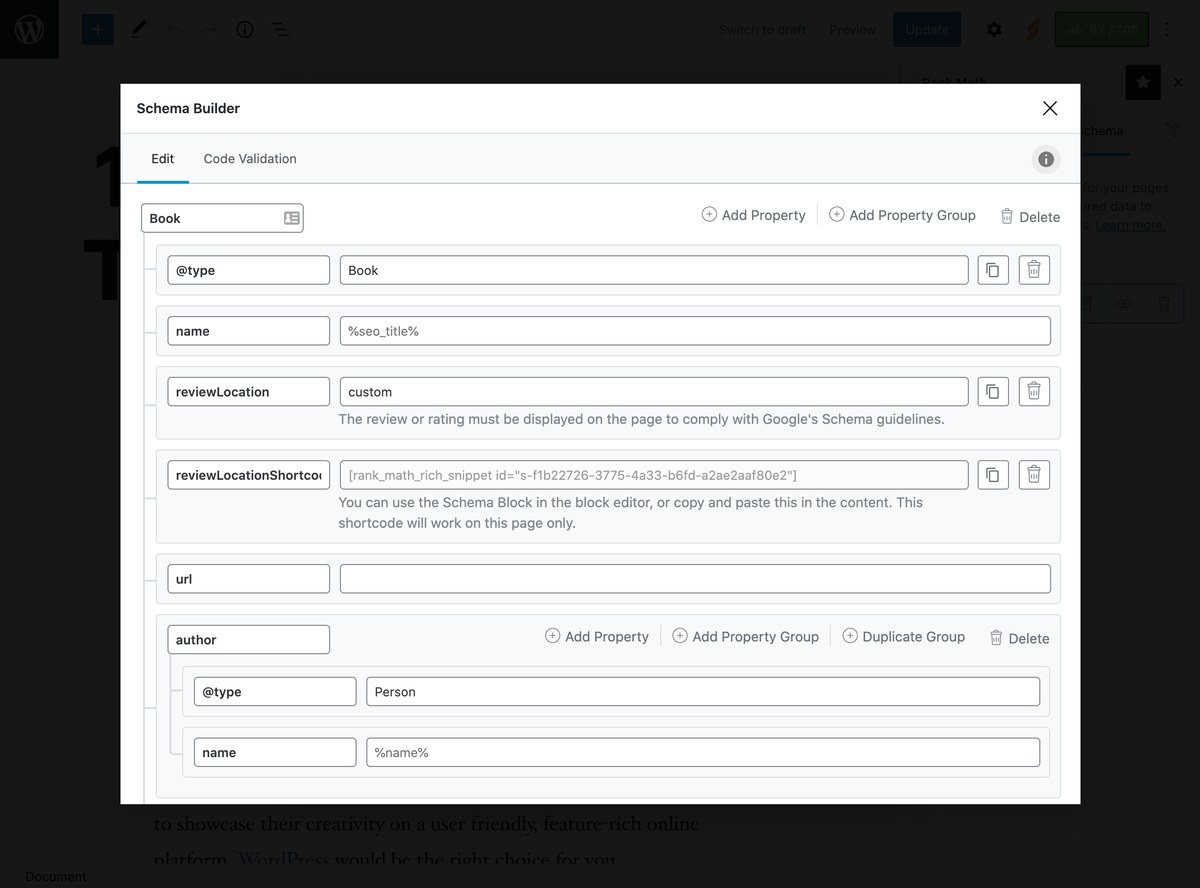
If you just want valid Article and Breadcrumb schema, either plugin is fine. If you publish reviews, recipes, software listings, courses or events and you want control over the markup, Rank Math PRO is the only one of the two with a real builder.
Yoast does not track your rankings. Rank Math PRO does, for 500 keywords on the base plan and 1,000 through the offer link, with 12 months of position history per keyword and per post.
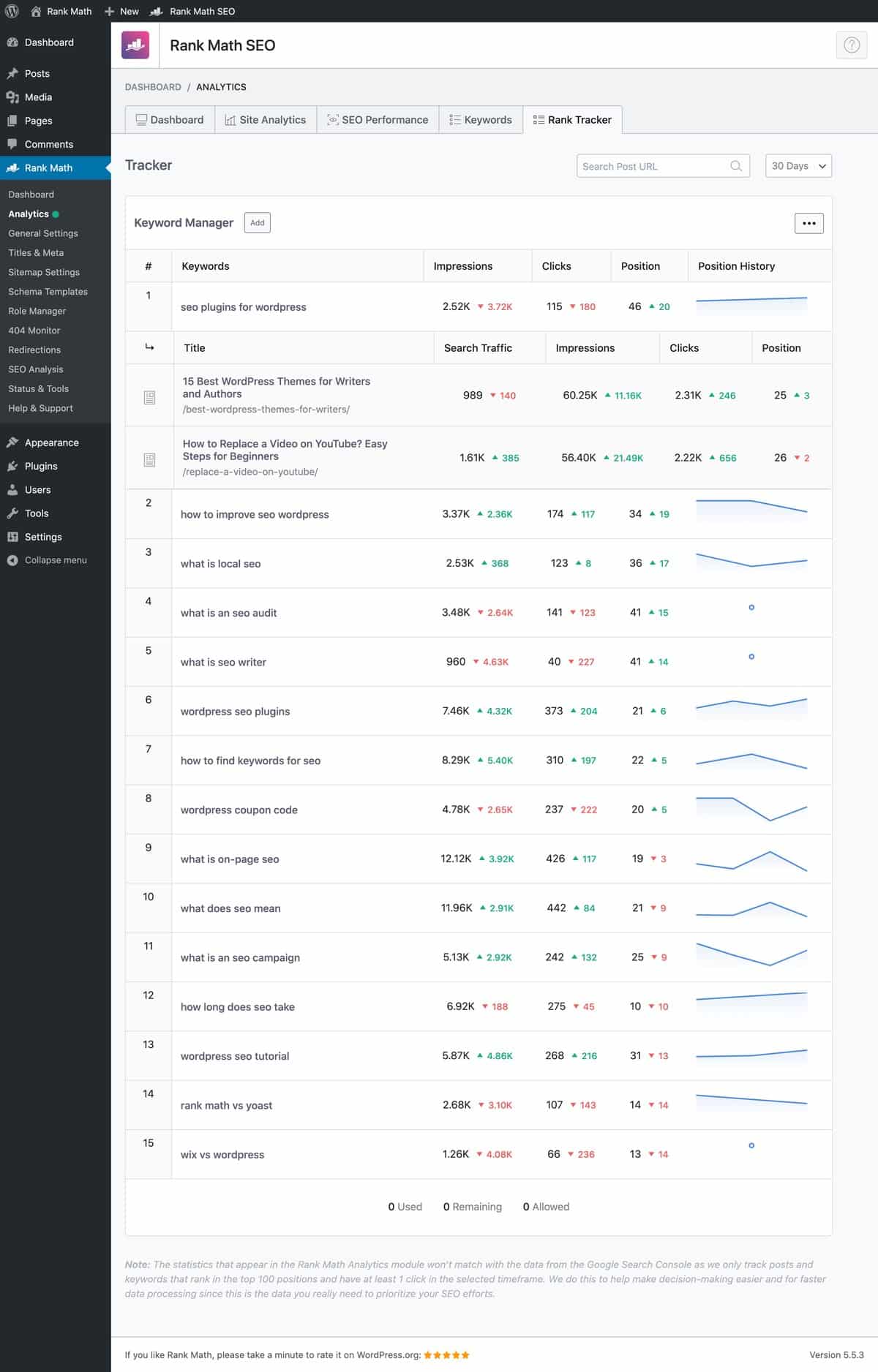
This is the feature that changes the maths for me. A standalone rank tracker costs $20 to $30 a month. Getting a usable one inside the SEO plugin I already needed means Rank Math PRO pays for itself before I count any other feature.
Be fair about the limits though: it pulls from Search Console, so it reports your average position, not a live check from a specific location. It will not replace a dedicated tool for local rank tracking or competitor monitoring at scale.
Both vendors shipped AI, and they went in noticeably different directions.
| Rank Math | Yoast | |
|---|---|---|
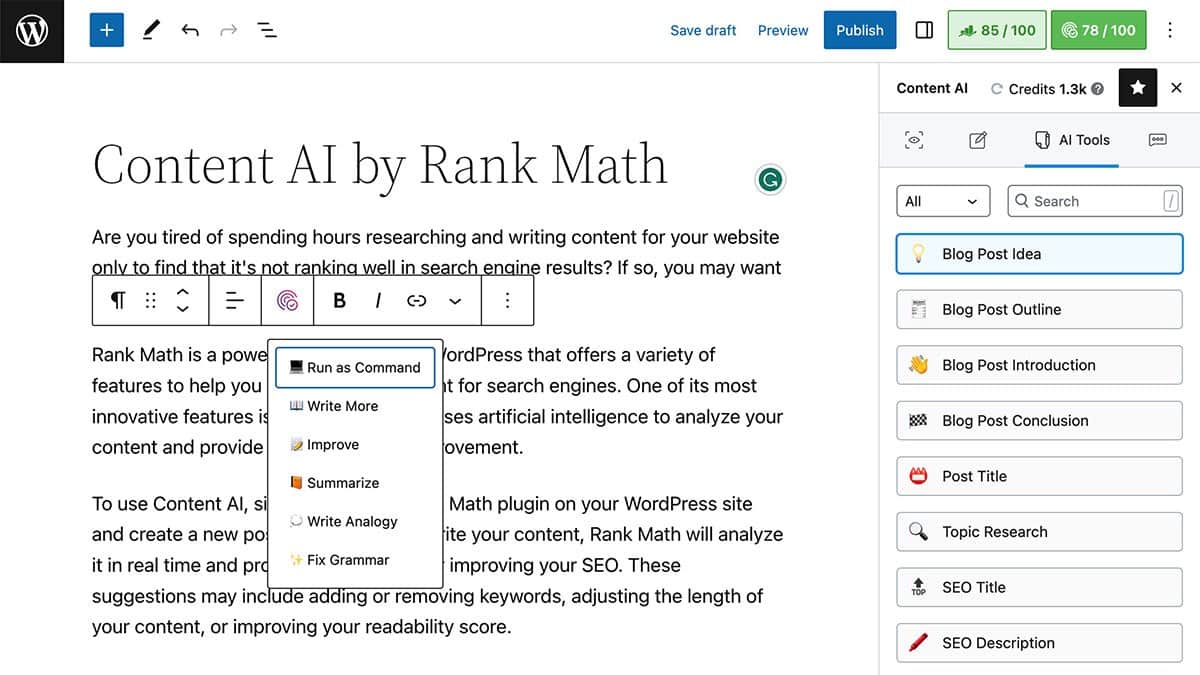
| Writing assistant | Content AI with 45 plus tools, brand voice and a research assistant | Content Planner suggests ideas and builds a starter draft |
| Metadata generation | Bulk generate SEO titles and descriptions | AI titles and descriptions, by page or in bulk |
| Internal linking | AI Link Genius, automatic keyword to URL linking | Suggestions while you write |
| Broken link checking | Yes, PRO | No |
| Competitor analysis | Yes, side by side SEO comparison | No |
| AI crawler control | No | Bot blocker, choose which AI systems may train on you |
| Where it runs | Inside WordPress | Inside WordPress and Google Docs |
Rank Math's AI is aimed at producing and optimising the content. Yoast's is aimed at clearing the backlog of metadata and giving a team a shared standard. If you write alone, Content AI is more useful. If you brief freelancers, the Yoast Google Docs seat is a real workflow advantage that Rank Math has no answer to.
Every comparison post repeats that Rank Math is far lighter than Yoast. That was true in 2021. In September 2026 the gap has narrowed a lot, and you should know that before you switch for speed reasons alone.
| Measure | Rank Math | Yoast SEO |
|---|---|---|
| Download size of the free plugin | about 3.6 MB | about 5.0 MB |
| Minimum PHP | 7.4 | 7.4 |
| Module based, disable what you do not use | Yes | Partly |
Rank Math is still the lighter install and its module system lets you switch off everything you do not need, which helps on shared hosting. A 1.4 MB difference in download size will not move your Core Web Vitals, though, so choose on features and licensing.
I use Rank Math and I earn a commission on it, so this is the section where I work hardest to be fair to the other side. Yoast wins on all of these.
None of that changes my recommendation for a multi site blogger, but if one of those points is the thing holding your workflow together, pay Yoast the $118.80 and do not look back.
I did this on a site that was already ranking, and nothing dropped. The import runs inside the Rank Math setup wizard and it is the step people lose the most sleep over for no good reason.
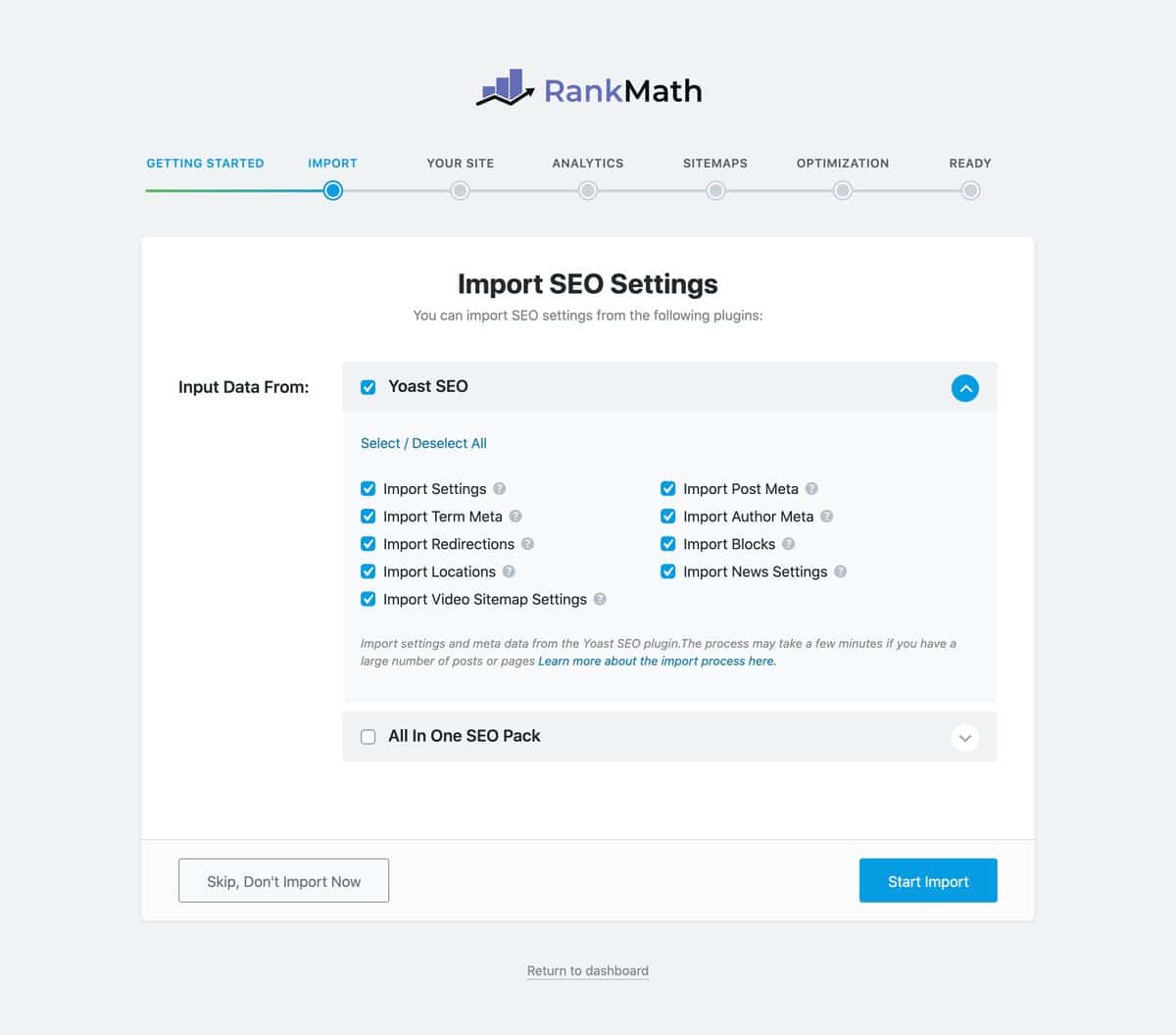
/sitemap_index.xml generated by Rank Math.Rank Math and Yoast both write title tags, meta descriptions and Open Graph tags. Leaving both active outputs two of everything, like two satnavs arguing over the same turn, which confuses crawlers and can suppress your snippet. Import, verify, then remove the old one.
Once you are on Rank Math, the free Instant Indexing module is the next thing worth switching on.
| If you are | Pick | Why |
|---|---|---|
| A new blogger with no budget | Rank Math Free | Redirects, 404 monitor and unlimited focus keywords without paying |
| Running two or more websites | Rank Math PRO | One licence covers unlimited personal sites, Yoast bills per site |
| Running one business site with a writing team | Yoast Premium | Google Docs seats, readability guidance and 24/7 support |
| A freelancer or agency with client sites | Rank Math Business | 100 client sites and 10,000 tracked keywords in one plan |
| Publishing reviews, recipes or events | Rank Math PRO | 840 plus schema types with a real custom builder |
| Needing Local, Video and News SEO on one site | Either, compare carefully | Yoast bundles all three in Premium, Rank Math splits them across PRO and Business |
| Already happy on Yoast and not multi site | Stay on Yoast | Switching for a $22.92 saving is not worth the afternoon |
Rank Math, for the licensing model more than the feature list. I run several sites, and paying once for all of them while getting a rank tracker in the same subscription is the reason I have never gone back. The discount applies automatically through the offer page, so there is no coupon code to hunt for.
For value, Rank Math. Its free plugin includes redirects, a 404 monitor and unlimited focus keywords that Yoast charges for or does not offer, and one PRO licence at $95.88 a year covers unlimited personal sites against $118.80 per site for Yoast Premium. Yoast is better if you want the strongest readability analysis, 24/7 support and the Google Docs workflow on a single site.
Yes. It handles titles, meta descriptions, canonicals, sitemaps, schema, redirects and breadcrumbs correctly, and it is used on more than 4 million sites with a 96 out of 100 rating on WordPress.org. No plugin makes you rank on its own, but Rank Math will not be the thing holding you back.
Both. Rank Math Free is a complete SEO plugin with no time limit and no feature nag, and it is what most blogs need. Rank Math PRO adds keyword rank tracking, the 840 plus schema builder, Content AI, AI Link Genius and client site management from $7.99 per month billed yearly.
Yes. Yoast has been the default WordPress SEO plugin for over a decade, it is installed on 10 million plus sites and it carries the same 96 out of 100 rating as Rank Math. Its readability analysis is the best in the category. The usual complaints are about money: useful features like redirects sit behind Premium, and the licence covers only one site.
Rank Math PRO is $7.99 per month billed yearly, which is $95.88 for unlimited personal sites. Yoast SEO Premium is $9.90 per month billed yearly, which is $118.80 excluding VAT for one site. Run three sites and Yoast costs $356.40 while Rank Math stays at $95.88.
Yes, and I have done it on a ranking site with no drop. The Rank Math setup wizard imports your Yoast titles, descriptions, focus keywords, robots meta and redirects in one click. Back up your database first, spot check a dozen posts after the import, then deactivate Yoast.
No, and you should not try. Both plugins write title tags, meta descriptions and Open Graph tags, so running them together outputs duplicates that confuse crawlers. Keep the old plugin active only long enough to import, then remove it.
Slightly. The Rank Math download is about 3.6 MB against about 5.0 MB for Yoast as of September 2026, and Rank Math's module system lets you switch off features you do not use. The old claims of a huge gap are out of date and neither plugin will meaningfully change your Core Web Vitals.
Yes, in the PRO plan. It tracks 500 keywords on the base plan, 1,000 through the offer link, with 12 months of position history. Yoast has no rank tracking at any price, so if you currently pay for a separate tracker this is where Rank Math saves real money.
Rank Math includes WooCommerce SEO in its PRO plans, covering product schema, the product sitemap and removing category and product bases. Yoast sells WooCommerce SEO as a separate purchase on top of Premium, so the total cost is higher.
Yes. Rank Math has a native panel in both builders so you can edit the SEO title, description and focus keyword without leaving the builder, and PRO converts Elementor and Divi accordion widgets into FAQ schema automatically.
Yoast SEO is the obvious one. SEOPress is a good lightweight option with a cheap unlimited site licence, and All in One SEO sits between the two on price. I compared Rank Math with SEOPress in a separate post if you want that side by side.
Yes, as of 2026 Yoast Premium bundles the Local SEO, Video SEO and News SEO plugins that used to be sold separately. If you need all three this narrows the price gap with Rank Math considerably, so factor it in before you compare sticker prices.
No. Start on Rank Math Free, publish for a few months, and only upgrade when you find yourself wanting rank tracking or custom schema. Buying a Pro SEO plugin on day one is the most common waste of money I see new bloggers make.
Disclosure: I am part of the Rank Math affiliate programme and earn a small commission if you buy through the links on this page, at no extra cost to you. I am not affiliated with Yoast, and the Yoast figures here come straight from their own pricing page. All prices and plugin data verified 10 November 2026. You can read exactly how I test, verify and update everything on this site.