Most advice about monetising an audience is really advice about getting more traffic. Those are different problems. In 2026 they are further apart than they have ever been, because AI answers are absorbing the informational searches that used to send you visitors, and the traffic that still arrives is fewer people with sharper intent.
That changes what you should build. A site earning from display ads needs volume it may never get back. A site earning from the same readers through products, affiliates and membership does not. This is a guide to the second kind.
The one number that matters
Stop tracking pageviews and start tracking revenue per 1,000 visitors. It is the only figure that tells you whether an audience is worth more this year than last. A blog doing 20,000 visits at 45 dollars per thousand is out-earning a blog doing 80,000 at 8 dollars, on a quarter of the traffic and a quarter of the hosting bill.
Every method below is graded on that, not on how much traffic it needs.
What actually changed for publishers in 2026
Two of the numbers everyone repeats are simply out of date, and they are the two that decide when you can stop using AdSense.
Mediavine no longer runs on a session threshold
The old rule was 50,000 sessions a month. Their programs page today lists Journey at 1,000 monthly sessions, and then gates every tier above it on annual revenue instead: Official above 5,000 dollars, Select above 100,000, Signature above 250,000, Premiere above 500,000 and Premiere Plus above a million.
In practice that means a small site can get premium ad management at 1,000 sessions a month. That was not true two years ago and it moves the decision point enormously.
Raptive is 25,000 pageviews, not 100,000
Raptive, previously AdThrive, asks for at least 25,000 monthly pageviews, Google Analytics configured properly, entirely original content, and a majority of traffic from the US, Canada, UK, Australia or New Zealand.
The 100,000 figure people quote is real but it applies to something else: the guaranteed RPM lift, which needs 100,000 monthly pageviews and more than 12,000 dollars of net ad revenue in the previous twelve months.
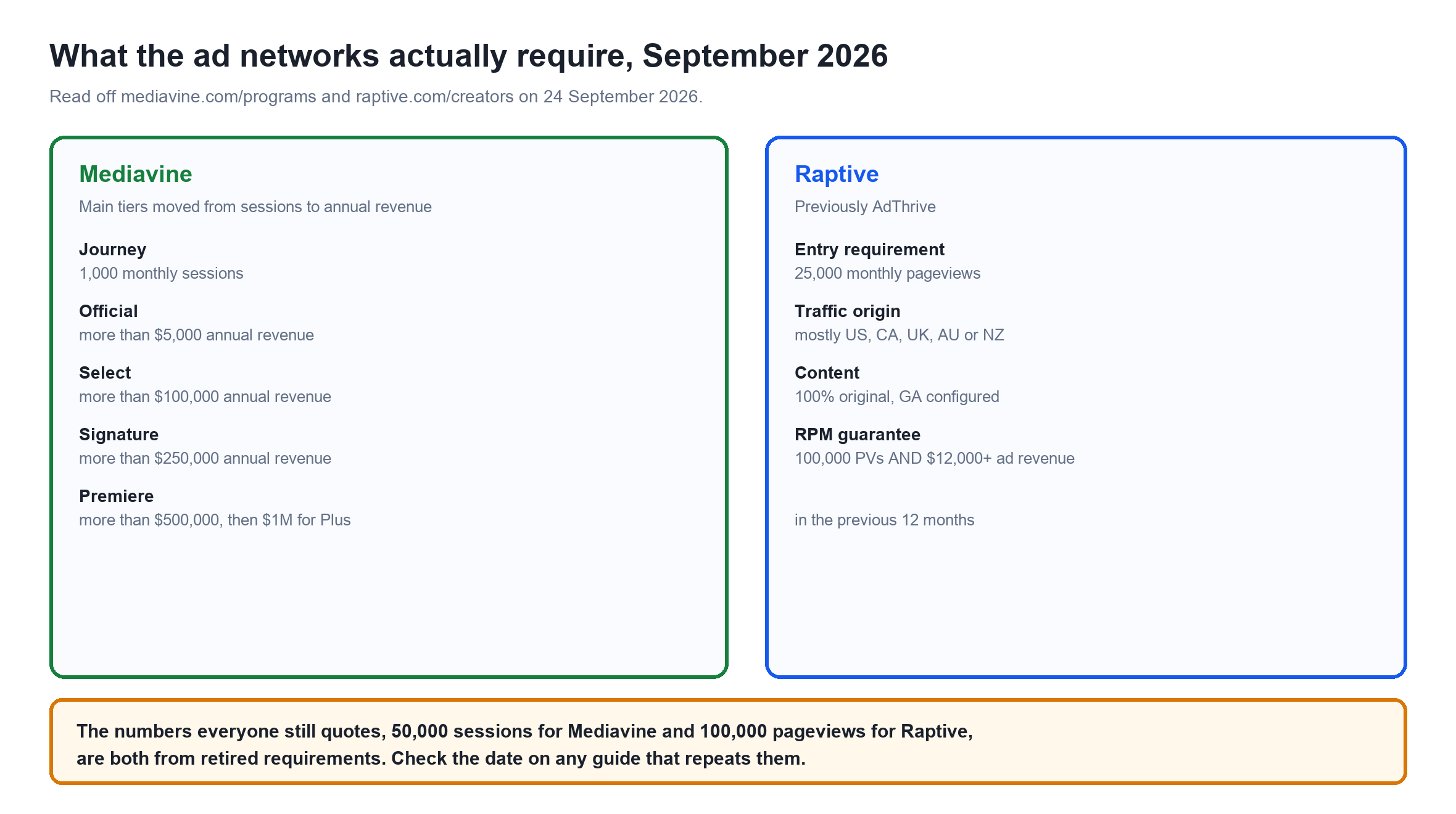
Both checked on their own pages on 24 September 2026. If a guide tells you different, check the date on it.
The eight ways to monetise, ranked by revenue per reader
| Method | Roughly what it earns | Traffic needed | Effort to set up | Best for |
|---|---|---|---|---|
| Your own product or course | Highest per reader by a wide margin | Very low, 500 engaged readers can work | High | Anyone with a specific, teachable skill |
| Services and consulting | Very high per reader | Lowest of all, 10 readers can pay a bill | Low | Starting out, or funding the rest |
| Affiliate marketing | High on commercial intent, near zero on informational | Low to medium | Medium | Reviews, comparisons, tools content |
| Paid community or membership | High and, crucially, recurring | Medium, needs an engaged core | Medium | Topics people want ongoing help with |
| Newsletter sponsorship | High per subscriber | Medium list, not medium traffic | Low | Anyone who has been collecting emails |
| Sponsored content | Lump sums, unpredictable | Medium and rising | Low per deal | Established niche authority |
| Display ads | Lowest per reader of anything here | High, and increasingly high | Lowest | Filling the gaps, not the plan |
| YouTube ad revenue | Low per view, high per subscriber downstream | High | Very high | Topics that genuinely need showing |
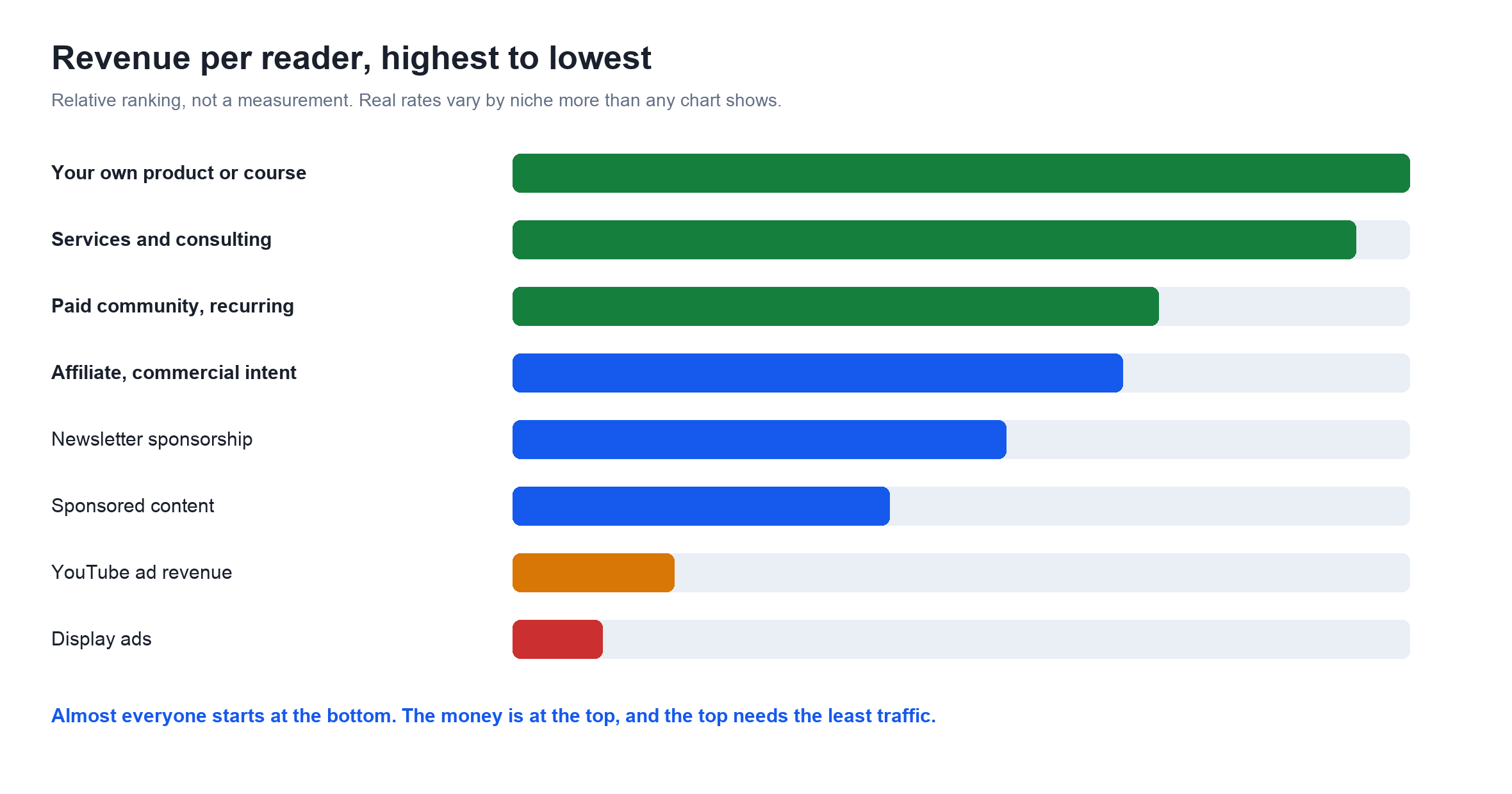
Notice the shape of that table. Almost everyone starts at the bottom with AdSense and works up. The money is at the top, and the top needs the least traffic.
1. Display ads, and why they should not be your plan
Ads are the easiest thing to switch on and the worst use of an engaged reader. You are renting attention you built, at a rate someone else sets, and paying for it in page speed.
- AdSense has no traffic minimum and RPMs that reflect that. Use it to learn what your audience is worth, then leave.
- Journey by Mediavine at 1,000 sessions a month is now the obvious next step, and it did not exist in this form when most guides were written.
- Raptive at 25,000 monthly pageviews, if your traffic is mostly from the five countries they name.
- Ezoic sits in between and will take you earlier, at the cost of heavier testing scripts.
The cost nobody puts in the ad revenue column
Ad scripts are the single heaviest thing most blogs load. They hurt Core Web Vitals, which hurts rankings, which reduces the traffic the ads are paid on. Before you add them, read the speed guide and measure what they cost you. An ad stack that adds two seconds to your Largest Contentful Paint can easily earn less than it destroys.
2. Affiliate marketing, where intent beats volume
Affiliate income does not scale with traffic. It scales with commercial intent. Ten thousand people reading “what is web hosting” are worth a fraction of two hundred reading “Kinsta vs Rocket.net” because the second group is deciding whether to spend money.
The pattern that works, in order:
- Write the comparison, not the review. Someone searching X vs Y has a credit card out. Someone searching X review is still browsing.
- Put the price and the renewal price in the post. The renewal rate is the number vendors hide and readers most want, and it is why people trust a page.
- Test the thing. Screenshots of your own dashboard are the difference between a page that converts and a page that reads like every other one.
- Disclose properly. Legally required, and it costs you nothing in conversions.
- Check your links still pay. Programmes close, brands get acquired, and a dead link earns nothing forever.
Worked examples on this site: Kinsta vs Rocket.net, NameHero vs Hostinger and WPvivid vs UpdraftPlus. Each one exists because someone is choosing between two products and wants a straight answer.
3. Your own product, the highest paid thing you can build
One customer paying you 49 dollars is worth roughly the same as 5,000 ad-funded pageviews on a decent RPM. You do not need a big audience for that maths to work. You need a small audience with a specific problem.
| Product type | Realistic price | How long to build | Sells best to |
|---|---|---|---|
| Template or preset pack | 9 to 49 dollars | A weekend | People who want the result, not the skill |
| Ebook or detailed PDF guide | 19 to 79 dollars | A few weeks | Beginners in your topic |
| Video course | 79 to 499 dollars | Months | People who have already failed once alone |
| Notion or spreadsheet system | 19 to 99 dollars | Days | Operators who want a process |
| Plugin, theme or small tool | 29 to 199 dollars a year | Months | A problem you personally hit |
On WordPress the selling side is a solved problem. Easy Digital Downloads handles digital goods properly, including licence keys and subscriptions, and the free version is enough to take your first payment.
The lead magnet loop
Give away the thing that proves you can help, collect the email, sell the thing that does the work. A free PDF that genuinely solves one problem is worth more than a popup offering a newsletter nobody asked for. This site does it with the blogging guide PDF.
4. Paid community and membership, the only recurring option
Everything else on this page is transactional. A membership is the only model where last month's work still pays this month. That is worth accepting a smaller number for.
- Price monthly, not one off. 9 dollars a month from 100 people is 10,800 a year from an audience most bloggers would call too small to monetise.
- Sell access to you, not to content. Content gets copied. Answers do not.
- Keep it small deliberately. A quiet community is a dead one, and 30 active people feel busier than 300 lurkers.
- Discord is free and good enough to start. Move to Circle or a WordPress membership plugin when the free tier actually hurts.
- Expect churn of a few percent a month and plan for it rather than being surprised by it.
5. Email, the asset nobody can take away from you
Search traffic is rented. Social reach is rented. An email list is the only audience you own outright, and in a year when AI answers are reducing click-through from search, that distinction stopped being a platitude and started being the whole strategy.
- Collect emails from day one even if you have nothing to send. The list compounds, the regret does not.
- One useful email a week beats a daily one you resent writing.
- Newsletter sponsorship pays per subscriber, and a small engaged list in a commercial niche is genuinely valuable.
- Your own launches convert several times better to a list than to search traffic.
If you are picking a provider, the ConvertKit alternatives comparison covers what each one costs once your list grows, which is where the pricing surprises live.
6. Video, expensive to make and worth it for the wrong reason
YouTube ad revenue on a small channel is not the point. The point is that video builds trust faster than text, and trust is what converts every other item on this list.
- Ad revenue needs real scale to matter, and requires 1,000 subscribers plus watch hours before it starts at all.
- Sponsorships pay far better than ads on the same channel, and start being available much earlier.
- Affiliate links in descriptions convert well on tutorial and comparison videos, for the same intent reason as text.
- Repurpose, do not duplicate. A video embedded in the matching post helps both. A video that just reads the post out helps neither.
What to add, and when
The order matters more than the choice. Adding ads too early caps what a page can earn for years, because it trains you to chase volume.
| Where you are | Add this | Do not bother with |
|---|---|---|
| Under 1,000 visits a month | Services, email collection, affiliate links on commercial posts | Any display ads at all |
| 1,000 to 10,000 | Journey by Mediavine, first small digital product | Sponsored post outreach |
| 10,000 to 25,000 | Lead magnet plus a real email sequence, more comparison content | Chasing a second traffic channel |
| 25,000 to 100,000 | Raptive if your traffic fits, membership if your topic suits it | Low value sponsored posts that cost trust |
| 100,000 plus | Premium ad tiers, your own course, sponsorship rate card | Doing any of it manually |
Five mistakes that cost the most
- Monetising informational content and wondering why it earns nothing. A how-to page converts badly because the reader wants to leave knowing something, not owning something. Monetise the decision pages instead.
- Adding every network at once. Ads plus popups plus a sticky bar plus a video player is how you turn a 2 second page into a 9 second one and lose the rankings that fed all of it.
- Never checking whether affiliate links still pay. Programmes close quietly. Test by cookie, not by whether the link loads.
- Treating the email list as a newsletter rather than an asset. The list is the business. The blog is how people find it.
- Optimising for traffic in a year when traffic is getting cheaper and attention is getting dearer. Revenue per thousand visitors is the metric. Everything else is vanity.
Related reading
- Ways to earn money online in India, with realistic income ranges
- How to increase AdSense CPC and RPM
- How to increase conversion focused traffic
- The complete blogging guide, with a free PDF
- AdSense link ads and what they do to CTR
- On page SEO that works without backlinks
Audience monetisation FAQs
How much traffic do I need before I can monetise?
Less than you think, if you pick the right method. Services and consulting can pay from a handful of readers. Affiliate income needs commercial intent rather than volume. Only display advertising genuinely requires scale, and even there Journey by Mediavine now starts at 1,000 monthly sessions.
What is the Mediavine minimum in 2026?
Journey by Mediavine starts at 1,000 monthly sessions. Their higher programmes are no longer gated on sessions at all but on annual revenue: Official above 5,000 dollars, Select above 100,000, Signature above 250,000, Premiere above 500,000 and Premiere Plus above a million. The old 50,000 sessions rule is gone.
What are Raptive's requirements?
At least 25,000 monthly pageviews, Google Analytics set up correctly, entirely original content, and a majority of traffic from the US, Canada, UK, Australia or New Zealand. The 100,000 pageview figure that circulates applies to their guaranteed RPM lift, which also needs more than 12,000 dollars of net ad revenue in the previous year.
Are display ads still worth it in 2026?
As a supplement, yes. As a strategy, no. They pay the least per reader of anything on this page and they cost you page speed, which costs you rankings. Use them to monetise traffic you cannot monetise any other way, not as the plan.
Affiliate marketing or my own product, which first?
Affiliate first, because it teaches you what your audience will actually pay for without you building anything. Watch which affiliate links convert, then build the product that sits in that gap.
How do I monetise without annoying my readers?
Match the method to the intent of the page. Commercial pages carry affiliate links and convert well. Informational pages collect emails. Nothing gets a popup before the reader has got what they came for. Most monetisation feels intrusive because it is on the wrong page, not because it exists.
Is a paid community worth the effort?
It is the only recurring revenue on this list, which makes it worth more than the headline number suggests. One hundred members at 9 dollars a month is 10,800 a year from an audience many people would consider too small to monetise at all. The cost is that a community needs you in it.
Do I need video to make money from an audience?
No, but it shortens the trust gap faster than anything else. The ad revenue is rarely worth the production time on a small channel. The value is that people who watch you buy from you more readily than people who read you.
How has AI search changed blog monetisation?
It is compressing informational traffic, which is the traffic display ads depend on, while leaving commercial intent traffic largely intact. That shifts the advantage towards affiliate content, owned products and email, and away from high volume how-to content funded by ads.
What is a good revenue per 1,000 visitors?
It depends entirely on the niche, so the useful comparison is against yourself last quarter rather than against someone else's screenshot. Track it monthly. If it is rising while traffic is flat, the strategy is working.
Can I use several of these at once?
Yes, and most established sites do. The sequencing table above is the order to add them in. The failure mode is adding them all at once, which slows the site and dilutes every call to action on the page.
Which method should I start with today?
If you have a skill, sell it as a service this week. It pays immediately, it needs no traffic, and the questions clients ask you are the outline of the product you will sell later.